
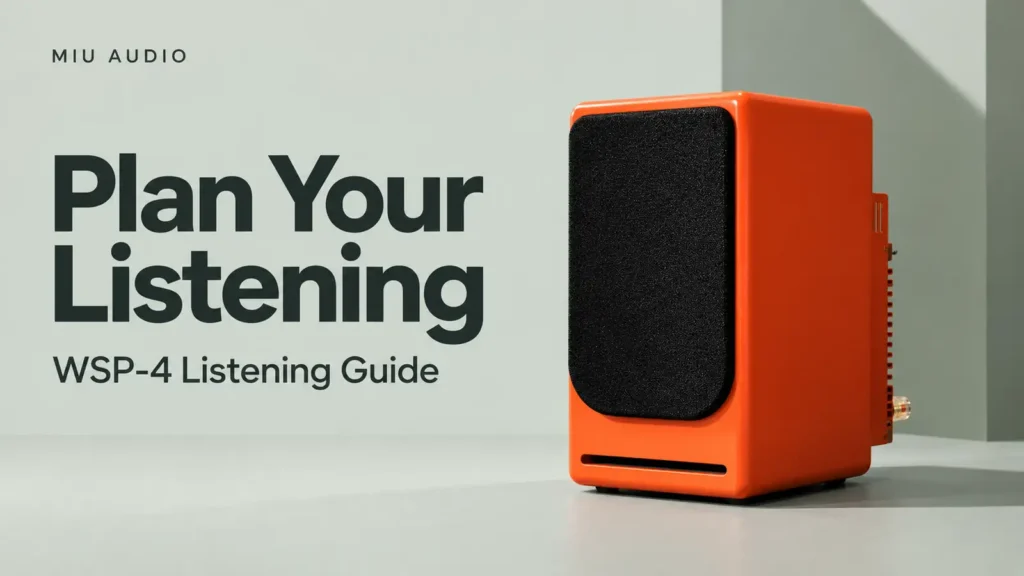
When considering WSP-4, decide whether your intended use is a single-speaker arrangement or a confirmed stereo-pair arrangement before planning the room. The product overview describes TWS pairing, but a successful setup also needs the correct instructions, channel roles and compatible units. This guide helps you prepare those questions; it does not announce stock, guarantee compatibility or replace the model's operating instructions.
Describe the listening job first
Write one sentence explaining how you want to use the space. Perhaps you want music in one everyday area, or perhaps you want a defined seated stereo session. Those are different planning goals. Do not assume that buying a second unit automatically answers the question, or that a single unit reproduces the same presentation as a correctly configured pair.
Next, identify where you expect to sit and where the equipment could safely stand. Consider access, cable routes and the normal use of the room. An arrangement that is awkward to power or easily knocked over is not improved merely by having more components. Leave exact clearances and operating conditions to the product instructions.
Ask what the pairing mode actually does
Use the WSP-4 overview as a starting point for the conversation. Ask which units and versions can pair, how the left and right roles are assigned, and what indication confirms that pairing is complete. Request the current instructions rather than relying on a generic wireless-speaker tutorial.
Also ask what happens after power is removed, a source changes or one unit disconnects. These are questions to confirm, not behaviour promised by this article. Do not assume that a pairing feature works with another model or that a mode name explains every input configuration. Keep uncertain items visible in your planning note.
Plan two safe positions, not two purchases
If a stereo pair is the intended arrangement, sketch two stable positions and the listening seat. Genelec's general placement guidance provides background on the relationship between a pair and a listening position; it does not specify WSP-4 distances or pairing behaviour. Use the sketch to ask a practical question about your room rather than to claim an ideal setup.
Check that both positions remain usable when the household uses the room normally. Record where power and any confirmed wired connections would go. Do not stretch a cable across a doorway or hide an unknown connection behind furniture. If the arrangement is not practical, reconsider the use case before changing equipment.
Request a clear demonstration
For a proposed demonstration, ask that the mode, source and channel arrangement be stated before playback. Use the same recording edition when moving between the confirmed single and paired arrangements. Keep listening comfortable and note any changes in source or settings. A different track or a larger playback level makes the comparison harder to interpret.
Describe your preference in relation to the intended use. You might value convenient everyday listening in one space, or a more defined seated arrangement. Neither conclusion proves that a particular pairing mode will operate with equipment that was not part of the demonstration. Keep the demonstrated configuration separate from the one you hope to build at home.
Take away a configuration note
Record the exact model identities, the confirmed mode, the source route and any unresolved questions. Ask which instructions apply to the proposed configuration. Do not include wireless passwords or account credentials in a public note. If availability or an Australian purchase route is relevant, obtain current confirmation separately.
Our Blog contains related listening preparation guides. Contact Miu Audio to discuss the intended arrangement. Learn More stays on the Australian site; this article does not provide an Australian checkout or invite payment for unconfirmed stock.
Frequently asked questions
Does TWS mean any two wireless speakers will work together?
No such assumption should be made. Confirm the exact compatible units, versions and instructions with Miu Audio before planning a pair. This article does not certify cross-model compatibility.
Is a pair automatically the better choice?
The useful choice depends on the intended listening job and practical room arrangement. Compare confirmed configurations rather than assuming that another unit always solves your particular requirement.
How should I confirm left and right channel roles?
Use the current WSP-4 instructions or ask for a demonstration of the relevant indicators and procedure. Do not infer channel assignment from the position of a unit alone.
Can I order the proposed arrangement from this article?
No. This is a planning guide, not a stock or compatibility confirmation. Ask for current product and purchase information through the official Miu Audio contact route.
Sources and scope
Miu Audio Featured Products describes the WSP-4 pairing feature. Genelec Monitor Placement provides general pair-positioning context. The questions above are an editorial planning checklist, not tested WSP-4 procedures.