
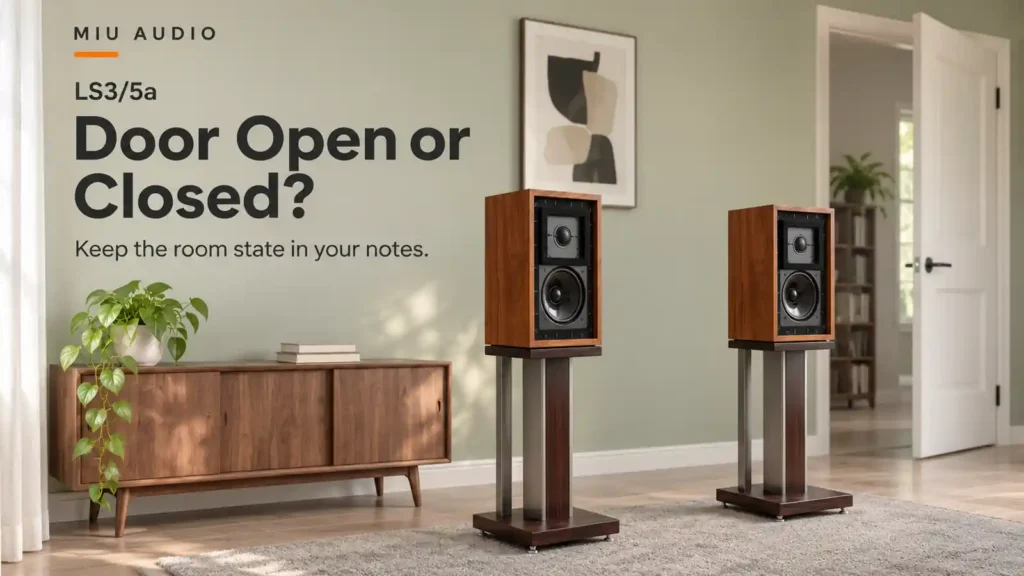
Compare the door state, not a new speaker position
To compare an open and closed listening-room door with an LS3/5a system, leave the speakers, seat, recording and volume setting unchanged. Listen with the door closed, repeat with it open, then return to the closed condition. Record the door position and background noise as carefully as the musical impression. Neither state is automatically better, and an audible difference does not identify a loudspeaker fault.
The useful question is narrow: does this ordinary household change produce a repeatable difference at your usual seat? You are not searching for a universal door angle or trying to turn the doorway into an acoustic treatment.
Understand what the comparison can establish
Genelec explains that sound reflected by room surfaces combines with direct sound, and that room and listener positions affect the result. An open doorway changes the room boundary arrangement and may admit sound from adjoining spaces. That makes its state worth documenting, but does not tell you the direction or size of any change in your home.
Room EQ Wizard describes a rectangular-room simulation with explicit boundary and sealing assumptions. Those assumptions are a useful warning against treating a simple room diagram as a prediction for a doorway leading into another space. This listening exercise measures no response curve and establishes no LS3/5a specification.
Define two safe, recognisable states
Choose fully closed and a practical open position that can be reproduced without obstructing access. Describe where the open leaf sits: against a wall, partly across the doorway or at its normal resting point. A partly open door is another condition, not interchangeable with every other opening. Make a small sketch showing the doorway relative to the speaker pair and seat.
Use only a door you may safely operate. Do not prop open a fire door, defeat a closer or alter building hardware. If closing it conflicts with required ventilation, access or household needs, omit that condition. The comparison is optional; keeping the room safe and usable takes priority.
Prepare one passage and a noise note
Select a short familiar passage containing a steady bass part and a clearly located voice or instrument. Write its start point and recording edition. This gives you two specific things to follow: the ends of bass notes and the apparent position of the central part. It avoids switching between unrelated tracks while also changing the room.
Before playback, pause for a moment in each door state. Note conversation, appliances or other sounds audible from outside the room. If the open condition admits obvious noise, do not increase the music to compete. You can record that the condition was less quiet without claiming that its acoustics were worse.
Run a closed-open-closed sequence
Begin at an ordinary comfortable level with the door closed. Play the passage and write one sentence. Pause playback, open the door, return to the same seat and replay from the same point. Leave tone controls, processing and the speaker arrangement alone. If someone assists with the door, ask them not to offer a verdict before you make your note.
Then close the door and repeat once. Compare the two closed-condition notes before deciding what the open condition meant. If they disagree substantially, the result is not yet dependable. A distracting noise, a different sitting posture or simply uncertainty can make another session more useful than repeated replays that afternoon.
Keep observation separate from preference
A useful entry might say, “With the door open, the last bass note seemed less prominent; adjoining-room speech was also audible.” That preserves two observations rather than inventing an explanation. “The open door fixed the room” goes further than the exercise supports. Likewise, a preference for a quieter closed room is a practical choice, not a diagnosis of bass behaviour.
Keep the result with the sketch and date. If you later compare speaker positions, use a consistent door state rather than silently changing both variables. Everyday listening can still follow household needs. There is no requirement to recreate a test condition whenever you want to enjoy an album.
The Miu Audio product overview identifies the LS3/5a; it does not prescribe a door state. Browse the listening guides for separate setup questions. Learn More about the LS3/5a without assuming a particular room result or current availability.
Frequently Asked Questions
Should an LS3/5a listening-room door always be closed?
No universal state is prescribed. Compare only safe household conditions and consider both music and incoming noise. Your preferred everyday arrangement may be a practical compromise rather than an acoustic optimum.
Is a partly open door the same as a fully open door?
No. Record the actual position and what lies beyond it. Treat a different opening as a separate condition rather than combining several door positions under one label.
Should I move the speakers during this comparison?
No. Keep the existing safe speaker and seat positions fixed for this question. A placement comparison can follow separately; changing both at once makes the door result difficult to interpret.
What if I cannot hear a consistent difference?
Record that outcome and stop. It does not prove identical acoustic responses, but it is enough to avoid making an unsupported claim or reorganising a useful room around an uncertain impression.