
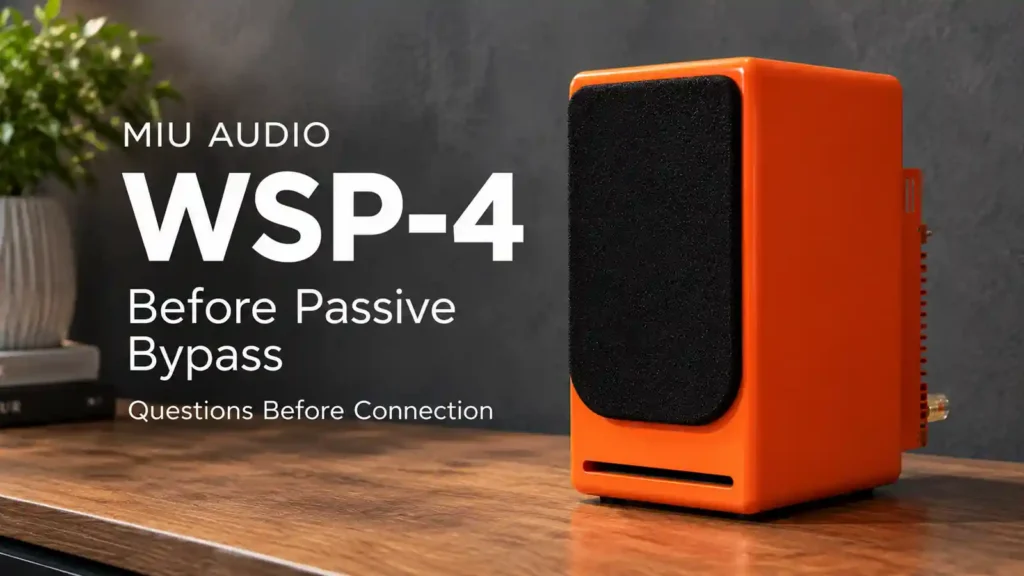
Before considering WSP-4 passive bypass, ask Miu Audio to confirm the exact mode, the terminals it uses and the operating instructions for the intended system. Do not treat bypass as another name for Bluetooth or analogue Line-in, and do not connect an external amplifier on the strength of a photograph. This is a product-education checklist for resolving those questions, not a connection procedure.
Separate the three descriptions
The WSP-4 product overview lists wireless playback, analogue Line-in through vacuum-tube circuitry and a passive loudspeaker bypass mode. Those descriptions identify different things to ask about. They do not say that the controls, inputs or operating sequence are interchangeable.
Write down the mode you actually want explained. “Play music from my usual source” is a useful starting goal, but it does not identify the path. Ask the demonstrator to name the input, the amplification arrangement and the control routine for that one mode. Keep the answers separate from any explanation of the other modes.
Why the amplification question matters
A loudspeaker system’s amplification arrangement is part of its design, not something that can be established by the cabinet’s appearance. Genelec’s technical explanation illustrates one active design principle: amplification is integrated with the individual drivers. That is general engineering context, not a description of WSP-4 circuitry or a recommendation of another product.
For WSP-4, ask specifically what the published bypass description means in the applicable manual. Which circuitry is in the selected path? Which terminals are intended for that mode? What equipment is required? Do not infer impedance, power limits or an amplifier match from the word “passive”. No such numerical recommendation is made here.
Build a mode-specific question card
Use a short written card so that a useful answer does not get lost among several possibilities. Record the exact WSP-4 unit or revision, the proposed source, the requested mode and the receiving or driving equipment. Add a space for the manual title or revision and for the answer to each unresolved question.
Ask who should perform the initial setup and what the owner is expected to do during normal use. Ask for the correct procedure before changing modes, connecting or disconnecting equipment. Do not open the cabinet, invent a cable arrangement or assume that a label visible in a promotional photograph is a complete instruction.
Keep a demonstration focused on one path
Begin with an explanation of the confirmed arrangement before playback. Ask which controls are active and which control sets the final listening level. Follow the demonstrated starting routine rather than reusing an old setting from another mode. If the instructions or compatibility remain unclear, pause the connection plan and resolve the question first.
Once the arrangement is established, listen to a familiar excerpt at a comfortable level. Note whether the operating routine is clear enough for the people who will use it at home. A listening impression cannot verify a power rating, prove a connection is safe or replace written operating guidance.
Choose the mode for the task
The useful question is not whether bypass is automatically an upgrade. It is whether a confirmed configuration serves the way you want to listen. Consider how often you change sources, where the equipment sits and whether you need to explain the routine to another household member. Ask for clarification of an unnecessary complication before adding it.
For ordinary source planning, read the separate WSP-4 Bluetooth and Line-In guide. That guide does not establish a bypass connection either. Contact Miu Audio with the exact model and proposed arrangement if you need a mode-specific answer. Keep private account information out of an equipment question.
Frequently asked questions
Is passive bypass simply another wireless input?
Do not treat it that way. The product overview lists passive bypass separately from wireless playback and analogue Line-in. Confirm its operation in the current WSP-4 instructions.
Does this guide recommend an external amplifier?
No. It provides no matching recommendation, power limit, impedance value or wiring arrangement. Ask for an exact, documented system confirmation rather than guessing from the feature name.
Can a product photograph tell me how to change modes?
No. A photograph cannot establish the required sequence or which controls and terminals apply. Use the relevant manual and a confirmed demonstration before making a connection.
Does the bypass feature mean it will sound better?
No universal improvement is claimed. Resolve the configuration first, then assess the confirmed routine in your own context. This educational preview does not establish current stock, pricing or availability.
Sources and scope
Miu Audio Featured Products is the source for the WSP-4 feature descriptions. Genelec Optimized Amplifiers supplies only the general active-design example noted above; it is not a WSP-4 manual, approval or product comparison. The question card is original editorial guidance. Explore more Miu Audio listening guides.