
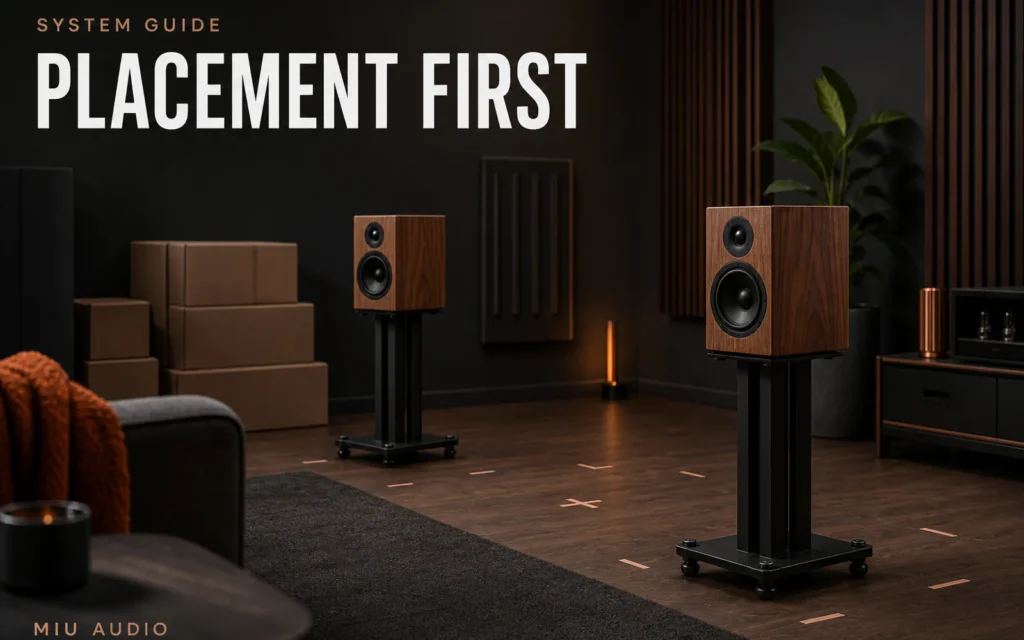
The short answer: spend one controlled session on wiring, stand height, equal distance, wall position, chair position, toe-in and source level before buying another component. Placement is free, reversible and can reveal whether the current problem belongs to the room, system match or equipment.
Genelec explains that speaker and listener locations affect room modes, boundary reflections and stereo imaging. Those effects can be larger than a small component difference. An upgrade should address a written limitation, not an undefined wish for more.
Turn the complaint into an observable problem
Replace needs better sound with a specific statement: vocals pull left, one bass note dominates, peaks sound hard, late-night level lacks clarity, or the source drops out. Each problem points to a different test.
Record when it happens, with which track and at what seat. A problem limited to one recording may not belong to the system.
Audit the no-cost baseline
- Check both speaker channels for correct polarity and secure wiring.
- Level stands and match speaker-to-seat distances.
- Test chair position in small front-back steps.
- Test speaker wall distance with equal moves.
- Compare straight and mild toe-in.
- Verify source format, gain and network stability.
Distinguish room, load and feature limits
| Observed problem | Likely first layer | Upgrade only after |
|---|---|---|
| Bass peak at one seat | Room placement | Position tests and measurement |
| Amplifier clips on peaks | System matching | Load and headroom check |
| Streaming dropouts | Network path | Wired stability test |
| Need private late listening | Use-case feature | Headphone and isolation assessment |
Compare the proposed upgrade against the baseline
Write what the new component is expected to change and how you will test it. Match loudness, preserve the same source and placement, and repeat the same excerpts. If the difference disappears when levels match, document that.
Include reliability, controls, ventilation, support and buying path. A useful upgrade can solve workflow or compatibility even when tonal difference is small.
Keep successful placement records
Photograph tape marks, toe-in and cable routing. Record chair distance and stand height. This becomes the baseline for future product auditions and prevents cleaning or room changes from erasing progress.
If no workable position solves the issue, the evidence is now strong enough for an acoustics, amplifier or product discussion.
Practical checklist
- The problem is written as an observable event.
- Polarity and secure wiring are confirmed.
- Stand, speaker and chair geometry are measured.
- Wall distance and toe-in are tested separately.
- Source and network stability are verified.
- The proposed upgrade has a testable job.
- The successful baseline is recorded.
Troubleshooting guide
| What you notice | Check first | Next step |
|---|---|---|
| Upgrade helps only when louder | Level matching | Rematch and repeat |
| Bass changes by seat | Room mode rather than component | Optimise chair and speaker position |
| Centre is vague | Polarity, distance and toe-in | Fix geometry before electronics |
| Current system lacks required feature | Workflow rather than sound claim | Specify the feature and compatibility |
Continue your Miu Audio research
The confirmed Miu Audio LS3/5a can be assessed against a documented placement baseline. Bring the room dimensions and amplifier details to a showroom discussion so the product is evaluated for a real task.
- Explore the confirmed Miu Audio LS3/5a
- Browse Audiophile Hi-Fi guides
- Plan a Springvale showroom visit
Frequently asked questions
What should I upgrade first in a hi-fi system?
Start by defining the problem and optimising wiring, speaker and chair placement. Upgrade the layer that remains demonstrably limiting.
Can speaker placement make a big difference?
Yes. It changes boundary interaction, room modes, reflections and stereo geometry, often at no equipment cost.
When is a new amplifier justified?
When the current amplifier is incompatible, lacks clean headroom or required features, or a matched audition demonstrates a useful improvement for the real load.
Should I buy acoustic treatment before new speakers?
Optimise placement and identify the room problem first. Effective treatment should address measured or repeatable issues rather than be added blindly.
Sources
- How To Place Your Monitors, Genelec, accessed 30 July 2026.
- Key Questions to Consider When Purchasing Your First Amplifier, McIntosh Laboratory, accessed 30 July 2026.
- Miu Audio Featured Products, Miu Audio, accessed 30 July 2026.
Placement-first testing reduces guesswork but does not replace electrical compatibility, structural acoustics or qualified service. Keep changes reversible and equipment within manufacturer limits.