
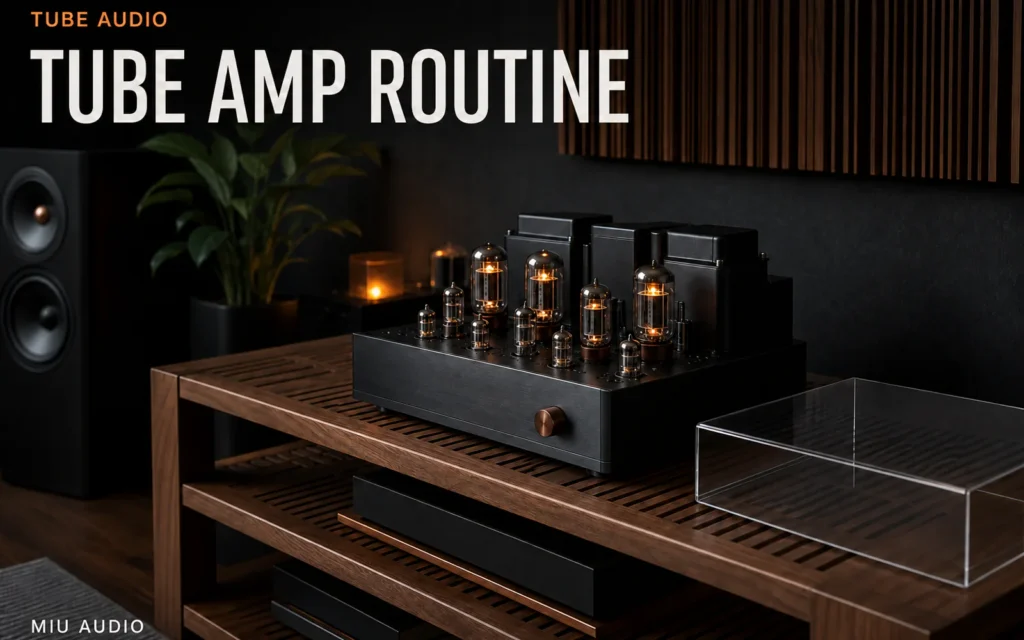
The short answer: connect the required load, set volume low, power up in the sequence stated by the amplifier maker, allow the specified stabilisation period, and shut down using the same manual. Do not invent a universal warm-up time or leave a hot tube amplifier unattended.
Tube designs differ. Rogue Audio documentation, for example, describes model-specific standby use and advises shutdown for a longer break. Other amplifiers use automatic delay, no standby switch or different bias requirements. The exact manual is the authority.
Prepare the system before power-up
Confirm speaker wiring, output taps and source connections with the amplifier off. Some tube amplifiers must not operate without an appropriate load. Set volume low and ensure ventilation clearances match the manual.
Keep papers, cloth, shelves and cables away from hot tubes and vents. Position the amplifier where accidental contact is unlikely.
Use the manufacturer's start-up sequence
- Check that speakers and required load are connected.
- Set volume low and select a known source.
- Use standby and power switches only in the stated order.
- Wait for the specified delay or stabilisation period.
- Begin playback quietly and increase level gradually.
- Observe the amplifier for abnormal noise, smell or tube behaviour.
Warm-up is not a performance competition
An amplifier may become operational quickly while its operating conditions continue to stabilise. The correct wait belongs to its design. Long unattended warm-up wastes tube life and increases heat exposure without creating a universal sonic benefit.
Evaluate sound after the normal routine, not by comparing a cold start at one level with a later session at another. Keep source and volume conditions consistent.
Understand standby and longer breaks
Standby can reduce operating stress during a short interruption on amplifiers designed for it, but it is not a universal all-day mode. Rogue Audio's Zeus manual advises powering off for breaks beyond a stated period, illustrating why users should not copy another model's routine.
For shutdown, reduce volume, stop the source and follow switch order. Let the unit cool before moving, covering or cleaning it.
Know what requires service
- A power tube plate glows red or changes dramatically from normal appearance.
- Repeated fuse failure, protection or bias that will not hold.
- Smoke, arcing, strong burning smell or unusual heat.
- New loud hum, crackling or channel loss after connection checks.
- Any procedure that requires opening the chassis or contacting internal parts.
Practical checklist
- The exact model manual is available.
- Speaker load and output taps are confirmed.
- Volume starts low and source is known.
- Ventilation and hot-surface clearances are open.
- Standby is used only as the manual permits.
- The amplifier is not left unattended.
- Cooling time is allowed before movement or cleaning.
Troubleshooting guide
| What you notice | Check first | Next step |
|---|---|---|
| No sound immediately after power-up | Normal start-up delay and mute circuit | Wait only as the manual specifies |
| Tube glows unusually red | Fault guidance, not normal filament glow | Power down and seek qualified service |
| Hum appears after warm-up | Source, tube and connection troubleshooting | Reduce system safely and follow the fault manual |
| Chassis is hotter than usual | Ventilation and operating condition | Shut down safely and investigate before reuse |
Continue your Miu Audio research
A stable operating routine makes tube-amplifier and speaker auditions more repeatable. Combine the exact amplifier instructions with the confirmed Miu Audio LS3/5a load and sensitivity information.
- Explore the confirmed Miu Audio LS3/5a
- Browse Audiophile Hi-Fi guides
- Plan a Springvale showroom visit
Frequently asked questions
How long should a tube amplifier warm up?
Use the time or sequence stated by the exact manufacturer. Designs vary, and longer unattended warm-up is not a universal improvement.
Should I leave a tube amp on all day?
Follow the manual. Heat, tube life and safety generally favour powering down for long breaks, and some manufacturers give a specific standby limit.
Can I play music during warm-up?
Only as the manual permits. Begin at low volume after the amplifier's start-up or mute delay has completed.
When is tube glow abnormal?
Normal heater glow differs by tube, but red-plating, arcing, smoke or sudden major change requires immediate safe shutdown and qualified service.
Sources
- Zeus Vacuum Tube Dual Mono Power Amplifier Owner's Manual, Rogue Audio, accessed 30 July 2026.
- MC275 Vacuum Tube Amplifier, McIntosh Laboratory, accessed 30 July 2026.
- Miu Audio Audiophile Hi-Fi, Miu Audio, accessed 30 July 2026.
Tube amplifiers contain heat and hazardous internal voltages. Never open the chassis, copy another model's bias or switch routine, or continue operating after abnormal heat, glow, smell, smoke or repeated faults.