
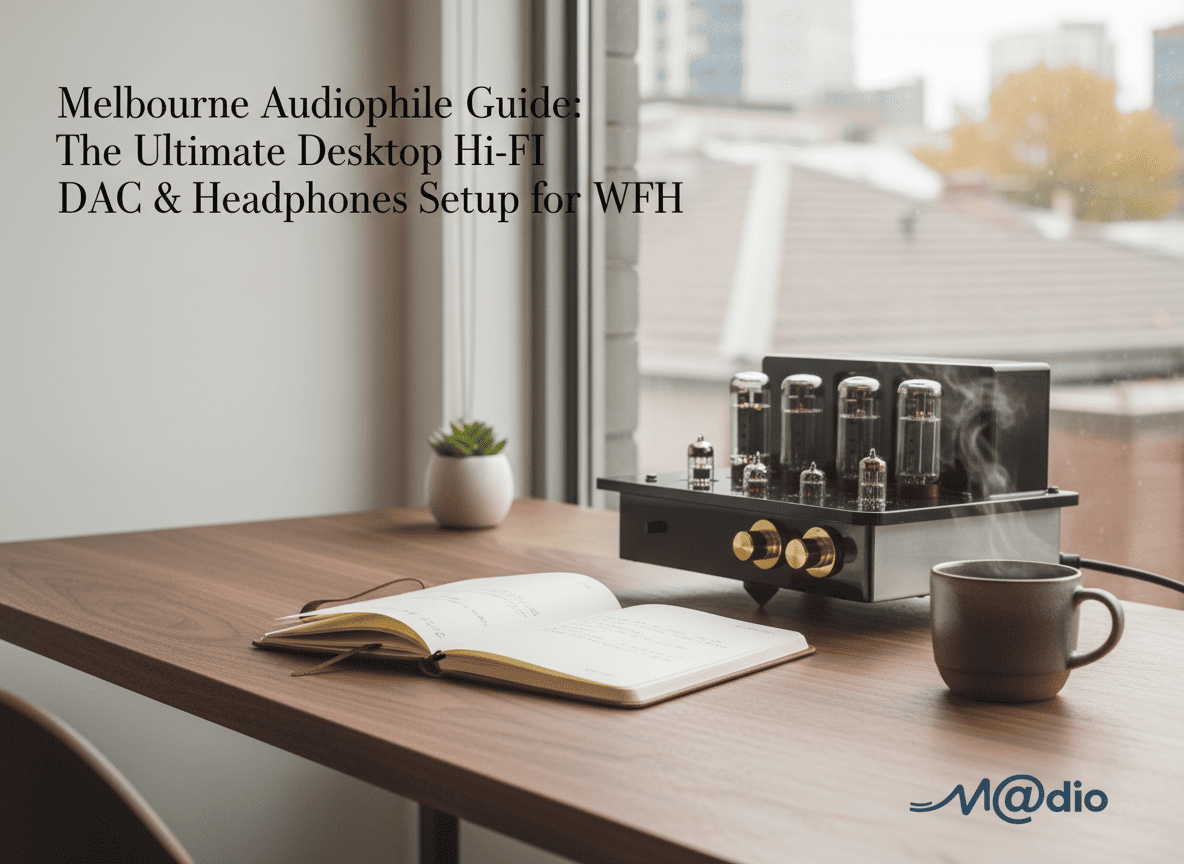
As late April brings a familiar chill to Victoria, the permanent shift to hybrid working models has driven Melbourne’s corporate sector indoors. Creating a productive and immersive home office is no longer just about ergonomic chairs and ultrawide monitors. A compact, high-resolution desktop stack featuring a premium DAC, dedicated amplifier, and planar magnetic headphones provides the ultimate tool for deep focus and fatigue-free listening.
The Science of Synergy: Output Impedance vs. Headphone Sensitivity
Building a high-end desktop Hi-Fi setup requires more than just matching price tags. The intricate relationship between amplifier output impedance and headphone sensitivity dictates your final acoustic result. When these electrical characteristics clash, even the most expensive gear can produce harsh treble or bloated, uncontrolled bass.
Planar magnetic headphones demand clean, robust current rather than simply voltage. Applying the industry-standard “rule of eighths” ensures your amplifier maintains proper electrical control over the headphone drivers. The amplifier’s output impedance should ideally be less than one-eighth of your headphone’s impedance, represented mathematically as \(\text{Output Impedance} \le \frac{\text{Headphone Impedance}}{8}\).
Headphone Impedance Matching Calculator
Test the theoretical synergy of your desktop stack before trusting the spec sheets.
Beyond the Spec Sheet
While calculators and manufacturer specifications provide a foundational understanding, they cannot account for real-world listening experiences. Every DAC and amplifier pairs differently with planar magnetic drivers, creating unique harmonic profiles. Relying solely on basic spec sheets without understanding these acoustic nuances often leads to mismatched purchases and eventual listening fatigue.
True audio appreciation requires careful component matching. Thoroughly researching the harmonic characteristics, understanding the transient response of your chosen drivers, and exploring how different setups decode an expansive soundstage are the most reliable methods to ensure your WFH desktop system performs flawlessly.
Frequently Asked Questions
Why are planar magnetic headphones good for hybrid working?
Planar magnetic headphones offer incredibly fast transient response and remarkably low distortion. This results in fatigue-free, crystal-clear audio that remains comfortable during long focus sessions or while analyzing high-resolution tracks throughout your workday.
What happens if my amplifier output impedance is too high?
A high output impedance alters the frequency response of your headphones. This poor electrical damping factor typically results in loose, muddy bass reproduction and potentially harsh high frequencies.
Do I really need a separate DAC and Amplifier for my laptop?
Yes, standard laptop audio components suffer from internal electrical interference and lack the necessary current to drive premium audiophile headphones properly. A dedicated DAC/Amp stack provides a clean, noise-free signal with dynamic authority.
Build a component worksheet instead of a one-number verdict
A useful desktop worksheet keeps conversion, amplification and headphone requirements separate. The 'rule of eighths' is a screening heuristic, not an industry certification or a guarantee of sound quality. It cannot establish how much usable level a particular pairing provides, and a planar driver does not automatically require a separate desktop stack.
- Write the headphone's model, nominal impedance and sensitivity, retaining the sensitivity's units. Do not combine a per-volt figure with a per-milliwatt figure as though they describe the same input.
- Record the amplifier's output impedance separately from its stated output power or voltage. Include the load and test conditions attached to the specification. Missing data should stay marked 'not provided', not be estimated from price or size.
- List the source's available connections and what the proposed DAC adds. A digital converter and a headphone amplifier have different roles, even when they share a chassis.
- Use the worksheet to ask the manufacturer a focused question about the exact pairing. If the existing computer output meets your practical needs, leave it in the comparison rather than assuming it must be replaced.
- Check daily usability too: reachable volume, repeatable startup level, microphone routing and cable strain. A technically suitable chain still has to work at the actual desk.
Worksheet questions
Can the calculator prove a system is fatigue-free?
No. It does not assess fit, listening duration, recording balance or personal comfort.
Do equal nominal impedances imply equal loudness?
No. Check sensitivity and the conditions under which it is specified.
What is an acceptable completed worksheet?
One that separates known specifications from open questions and names the function of every device. It need not lead to a purchase.
Engineering background: headphone sensitivity and load-dependent output requirements.