
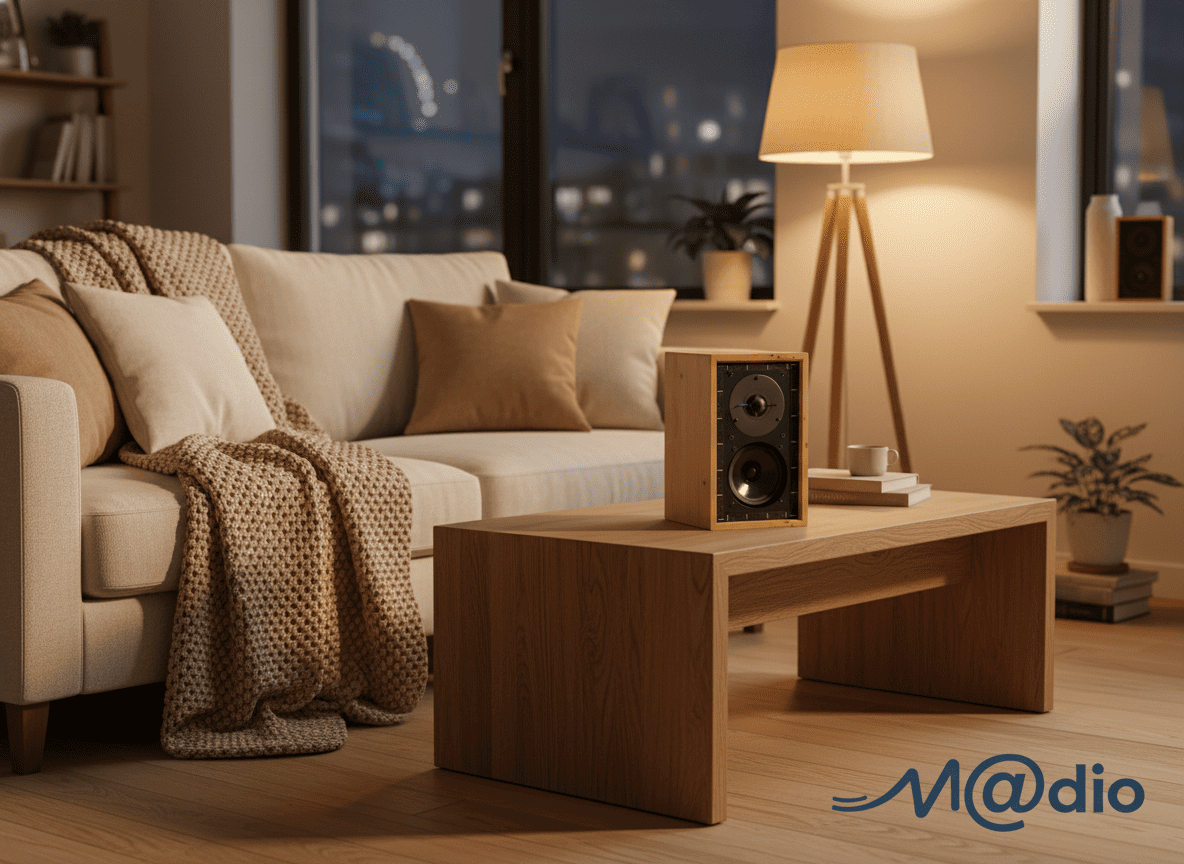
With the busy Easter holiday period now behind us, Melbourne is settling back into a quieter rhythm. As the autumn air turns crisper, our focus naturally shifts inward. For local audiophiles and music lovers, this post-holiday calm is the perfect opportunity to orchestrate a personal audio reset—transforming the living room into an immersive, high-fidelity retreat for the cooler months ahead.
The Elegance of Premium Bookshelf Speakers
When curating a living room system, aesthetics and acoustics must exist in harmony. While massive floorstanding speakers might seem impressive, they often visually dominate a room and can create overwhelming, muddy bass in small-to-medium Melbourne apartments. Premium bookshelf speakers, placed meticulously on heavy, dedicated stands, offer an elegant solution. They “disappear” into the room, casting a precise, holographic soundstage that makes artists feel as though they are performing right in front of you.
The Deception of the Spec Sheet
However, elevating your living room requires more than simply adding high-end speakers to an online shopping cart. One of the most dangerous traps in Hi-Fi is purchasing equipment based solely on internet spec sheets or forum hype. A speaker is only as good as the amplifier driving it. A highly detailed speaker paired with a cold, analytical amplifier can sound painfully harsh. Conversely, a warm tube amplifier might fail to control the dynamic bass of a low-sensitivity speaker. Buying audio gear blindly online completely ignores the critical element of synergy.
Interactive: Room Synergy & Amplifier Pairing Guide
Not sure what kind of integrated amplifier your living room needs? Enter your dimensions and listening preferences below.
The Art of Achieving Audio Synergy
Because room acoustics and amplifier pairings drastically alter a speaker’s true potential, relying solely on specification sheets is never enough. To truly elevate your living room, it is essential to physically verify how an integrated amplifier interacts with your chosen bookshelf speakers. Finding the right pairing can beautifully tame a bright treble or unleash deep, punchy dynamics.
Building a high-fidelity sanctuary means making informed, strategic choices. By ensuring your amplifier and speakers are perfectly matched, and securing your investment with reliable local Australian warranty support, you protect yourself against the risks of overseas grey-market imports and guarantee a breathtaking, immersive listening experience for years to come.
Frequently Asked Questions
Why choose bookshelf speakers over floorstanding speakers?
In small to medium-sized rooms, bookshelf speakers excel at precise imaging and soundstage accuracy. Because they have smaller cabinets, they are less prone to cabinet resonance and “room boom” (overwhelming bass reflection) that floorstanders often suffer from in tighter spaces. They offer a cleaner, more articulate presentation.
Do I need a subwoofer with high-end bookshelf speakers?
It depends entirely on the amplifier synergy and your room’s acoustics. Many premium bookshelf speakers driven by a high-current integrated amplifier can produce astonishingly deep, tight bass on their own. We recommend establishing the core 2.0 system first; you can always integrate a high-fidelity subwoofer later if your room requires it.
What exactly does an integrated amplifier do?
An integrated amplifier combines a preamplifier (for input switching and volume control) and a power amplifier (to provide the electrical muscle to drive the speakers) into a single, elegant chassis. The design of this amplifier—whether Class A/B, Class D, or Tube Hybrid—dictates the overall tonal “flavor” and control of your speakers.
Check the living room before changing the loudspeakers
A post-holiday reset can begin with a reversible layout audit. Small cabinets are not inherently immune to resonance or room interaction, and a larger amplifier cannot by itself extend a loudspeaker's physical bass limits. Identify the listening problem before selecting a different component.
- Take a photograph from the main chair and note any obstruction between each speaker and the listener. Check that the support is stable and appropriate for the speaker, following its instructions.
- Use a centred voice to check whether the image pulls sideways. Compare the left-right layout, speaker heights and distances before assuming that the amplifier has a tonal mismatch.
- Walk back to the usual chair after listening briefly elsewhere. If one bass note changes strongly with position, record where it becomes more or less prominent. That observation points to a room/placement question worth examining.
- Try one modest speaker or chair movement, measure it and keep a route back to the original layout. Avoid adding a new amplifier and moving the furniture during the same comparison.
- Only after placement is workable, list what is still missing. This might be an input, a practical control or low-frequency extension; those needs call for different investigations.
Living-room reset questions
Will a rug solve every bass problem?
No. Furnishings can change reflections, but a thin decorative treatment is not a general low-frequency cure.
Should I copy a studio monitor's wall distance exactly?
No. Use general acoustic principles while checking your own loudspeaker's instructions and room, rather than transferring a model-specific prescription.
Background: placement and listening position; reflection and absorption principles.