
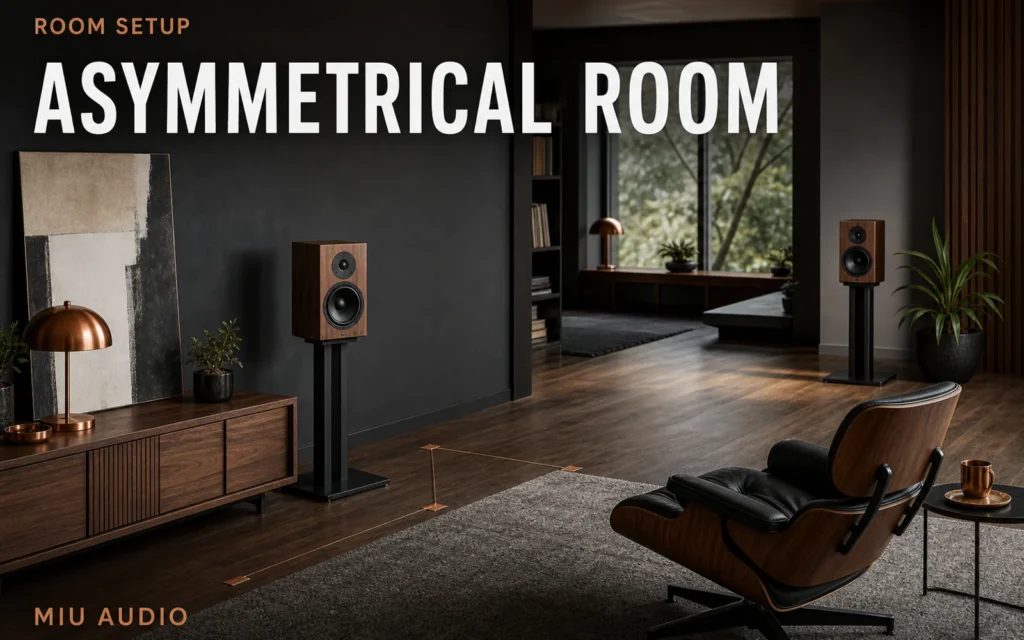
The short answer: preserve the variables you can control. Match speaker-to-listener distance, stand height, cabinet orientation and channel polarity. Start the seat on a workable centre line, then treat unequal walls, openings and furniture as separate reflection and bass variables.
Genelec notes that the most accurate stereo imaging begins with similar left and right reflection conditions and equal placement relative to boundaries. A domestic room may not allow perfect symmetry, but measured geometry still creates a dependable baseline.
Map the room before moving equipment
Sketch walls, doors, windows, large furniture and open passages. Measure speaker-to-seat distances and each speaker's nearest side and rear boundary. Photograph the starting layout and mark the floor with removable tape.
Do not treat a curtain and an open doorway as equal because they look balanced from the chair. Their acoustic behaviour differs, so first secure geometry and then test the room effect.
Keep the direct sound relationship equal
- Set both speakers to the same height and level.
- Measure each acoustic axis to the listening position.
- Match initial toe-in using cabinet edges.
- Confirm both channels have correct polarity.
- Use a mono vocal to assess the centre.
- Correct distance before making unequal angle changes.
Address the first-reflection imbalance carefully
A hard close wall on one side and an open space on the other can pull tonal or spatial attention. Ordinary furnishings may reduce some high-frequency reflection, but random absorption can also create uneven tonal balance.
Use reversible changes such as curtain position, a movable absorber approved for the room, or small speaker placement shifts. Structural acoustic treatment should be designed or reviewed by a professional.
Do not solve every issue with channel balance
A balance control can recentre level at one frequency or seat, but it does not equalise different reflection timing or bass modes. Use it only after the physical setup is measured and only as the equipment manual permits.
If the centre shifts by track or frequency, investigate placement and room response rather than applying one permanent level offset.
Choose the best repeatable compromise
Test central vocals, panned instruments and bass notes at normal level. Move one speaker or the chair by a small amount, record the effect and restore the baseline before the next experiment.
Shared rooms also need access, safety and aesthetics. A slightly less precise central image may be the right outcome if the alternative blocks a door or leaves unstable stands exposed.
Practical checklist
- A simple room map records hard boundaries and openings.
- Both speaker-to-seat distances match.
- Stand height, polarity and initial toe-in match.
- Mono material is used to check centre stability.
- Unequal reflections are tested with reversible changes.
- Balance control is not the first fix.
- The final layout remains safe and usable.
Troubleshooting guide
| What you notice | Check first | Next step |
|---|---|---|
| Vocal consistently pulls to one side | Distance, level and first reflections | Correct geometry before room treatment |
| Centre shifts with different frequencies | Unequal boundaries and room response | Test small position and furnishing changes |
| Bass differs strongly left to right | Corner and wall distances | Move in measured increments and reassess the seat |
| Balance setting fixes only one track | Reflection rather than channel gain | Return balance to baseline and investigate placement |
Continue your Miu Audio research
Compact speakers provide useful placement flexibility. Use the Miu Audio LS3/5a overview with exact room measurements, then apply the stand and toe-in guides as controlled follow-up steps.
- Explore the confirmed Miu Audio LS3/5a
- Browse Audiophile Hi-Fi guides
- Plan a Springvale showroom visit
Frequently asked questions
Can stereo work in an asymmetrical room?
Yes, although the result may require compromise. Equal direct distances, height and angle create a strong baseline before addressing unequal reflections.
Should one speaker have more toe-in?
Start with equal angles. Use unequal toe-in only as a measured final adjustment after distance, polarity and boundary conditions are understood.
Can curtains balance a hard wall?
Curtains can affect some reflections, mainly at higher frequencies, but they do not copy an open space or solve bass modes. Test changes and avoid assuming visual symmetry equals acoustic symmetry.
Should I use the amplifier balance control?
It can correct a simple level offset, but not reflection timing or room modes. Use it after physical checks and document the setting.
Sources
- How To Place Your Monitors, Genelec, accessed 30 July 2026.
- Dolby Atmos Speaker Setup 101, Dolby, accessed 30 July 2026.
- Miu Audio Featured Products, Miu Audio, accessed 30 July 2026.
Room changes can affect safety, access and building surfaces. Use reversible tests and consult an acoustics or installation professional for mounted treatment or structural work.