
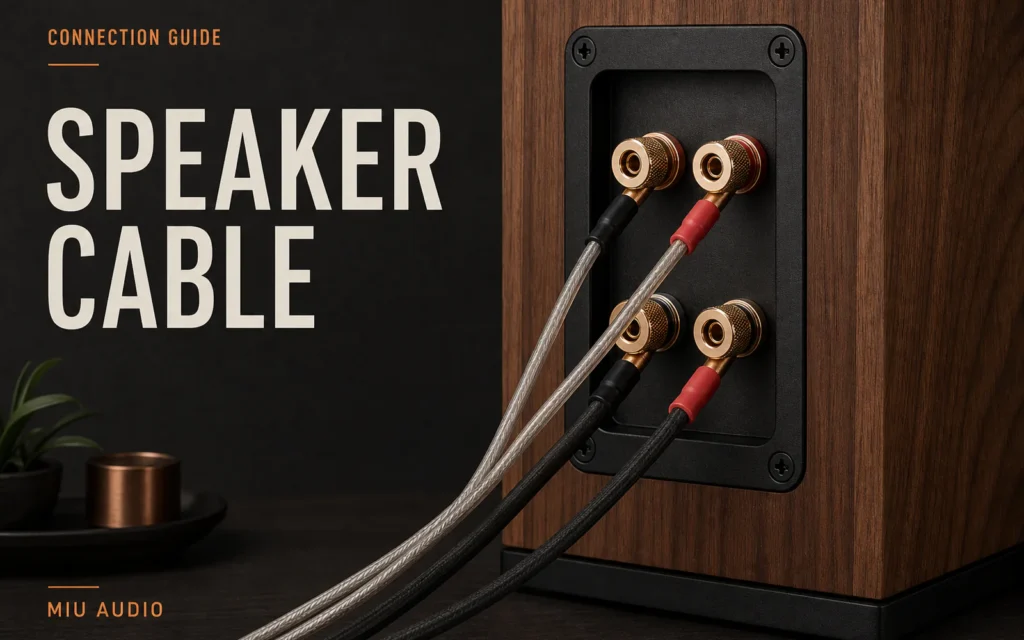
The short answer: use an adequately thick, low-resistance speaker cable for the run length and loudspeaker impedance, keep left and right routing practical, and make clean secure terminations. Expensive materials do not fix a cable that is too thin, loose, shorted or incorrectly connected.
Cambridge Audio identifies resistance as the main speaker-cable property to manage and relates it to length, conductor area and loudspeaker impedance. Manufacturer manuals also provide model-specific gauge tables for longer runs. Use those sources rather than a universal shopping slogan.
Start with length and load
Measure the actual route from amplifier to each speaker, including safe slack and furniture turns. A longer cable has more resistance, while a thicker conductor has less. Lower-impedance speakers make cable resistance a larger percentage of the load.
A 15-ohm nominal loudspeaker is a different electrical case from a 4-ohm model, but cable still needs secure construction and suitable current capacity. Check both the loudspeaker and amplifier manuals for any minimum conductor requirement.
Use manufacturer tables as conservative references
Cambridge Audio publishes example length-and-gauge relationships intended to keep cable resistance small relative to speaker impedance. McIntosh manuals also provide gauge tables for their amplifier terminals and supported loads.
Do not combine the most generous numbers from different tables. Connector limits, installation method and local electrical rules can change the safe choice. For concealed or in-wall runs, use cable rated for that installation and engage a qualified installer.
Termination quality matters
- Power the amplifier off before preparing or connecting cable.
- Expose only the conductor length specified by the terminal maker.
- Twist strands neatly so none can bridge to the other post.
- Maintain the same polarity marker at both ends of each channel.
- Tighten binding posts firmly without damaging them.
- Add strain relief so movement cannot pull bare wire free.
Equal length is useful, but excess coils are not a goal
Reasonably similar left and right runs keep resistance comparable and simplify installation, but forcing a large coil of unused cable beside mains leads can create clutter and trip risk. Route the shortest practical safe path for both channels.
Keep speaker cables separated from sharp edges, heat sources and power connections where the equipment manuals advise it. Label both ends before a rack becomes crowded.
Evaluate claims with the complete system
Once resistance, gauge, termination and routing are appropriate, claims about exotic conductors should be treated as listening preferences requiring controlled comparison. Match level and do not change cable length, connector tightness and amplifier setting at the same time.
Spend first on correct placement, secure connections and compatible equipment. Cable cannot correct a room null, reversed polarity or an unsuitable amplifier load.
Practical checklist
- Both cable routes are measured before purchase.
- Gauge suits the run length and nominal speaker impedance.
- Any in-wall cable has the required installation rating.
- Terminals accept the chosen bare wire, spade or banana connector.
- Polarity markers are consistent at all endpoints.
- No loose strands or exposed conductor can short.
- Cables avoid heat, sharp edges and walking paths.
Troubleshooting guide
| What you notice | Check first | Next step |
|---|---|---|
| One channel cuts out when cable moves | Loose termination or broken conductor | Power down and remake or replace the connection |
| Amplifier enters protection | Stray strands and shorted terminals | Disconnect power and inspect every endpoint |
| Bass is weak with both speakers | Polarity and amplifier settings | Correct wiring before changing cable type |
| Long run uses very thin cable | Manufacturer gauge table | Replace with an appropriate conductor size |
Continue your Miu Audio research
The Miu Audio LS3/5a has a confirmed 15-ohm nominal specification. Use that fact with the actual route length and amplifier terminal requirements when selecting cable, then focus on repeatable placement.
- Explore the confirmed Miu Audio LS3/5a
- Browse Audiophile Hi-Fi guides
- Plan a Springvale showroom visit
Frequently asked questions
What gauge speaker cable should I use?
Choose from the actual run length, loudspeaker impedance, terminal capacity and manufacturer guidance. Longer runs and lower impedances generally call for thicker conductors.
Do left and right speaker cables need equal length?
Keeping runs reasonably similar is practical, but do not create large unnecessary coils. Use the shortest safe routes that suit the room and maintain adequate gauge.
Are banana plugs better than bare wire?
They can improve convenience and strand control when the terminals permit them. A secure correctly sized connection matters more than connector style alone.
Can speaker cable change the sound?
Excessive resistance, poor contact, incorrect polarity or faults can affect performance. Claims beyond adequate electrical and mechanical behaviour should be assessed with controlled listening.
Sources
- Speaker Cables – What You Need To Know, Cambridge Audio, accessed 30 July 2026.
- MC2301 Tube Power Amplifier Owner's Manual, McIntosh Laboratory, accessed 30 July 2026.
- Connecting speakers, Yamaha, accessed 30 July 2026.
Use cable and connectors approved for the equipment and installation. Power down before wiring, keep protective electrical work for qualified installers and follow local requirements for concealed cable.