
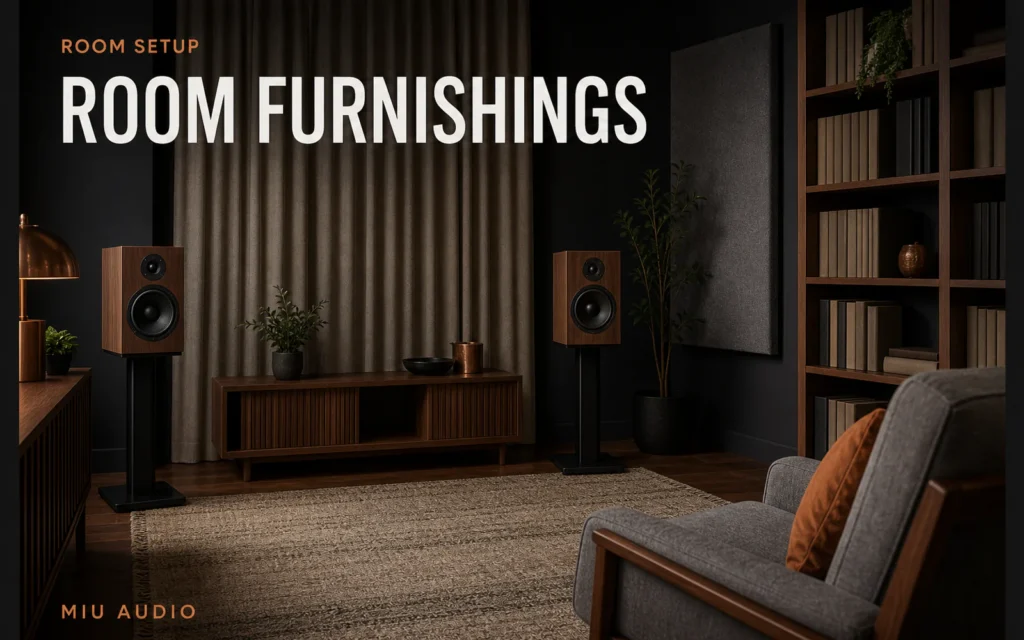
The short answer: soft furnishings can reduce some high-frequency reflections and overall liveliness, while irregular bookshelves may scatter some sound. They do not reliably solve low-frequency room modes, and random treatment can make left and right conditions less consistent.
Genelec explains that sound reflects from walls, ceilings and floors and that similar left-right reflections support stereo imaging. Dolby also recommends reducing excessive hard-surface reflection. The useful approach is measured placement first, then reversible furnishing tests.
Understand frequency-dependent behaviour
Thin fabric and a light rug mainly affect shorter wavelengths. Deep bass wavelengths are much longer and usually pass through or around ordinary decor. A room can sound less bright while still having the same bass peak.
Avoid claiming full-range absorption without measured product data and installation details. Thickness, air gap, area and material all matter.
Use rugs for floor reflection and comfort
A rug between speakers and seat can reduce some floor reflection in a hard room, especially when it covers a meaningful area. It can also improve practical comfort and reduce foot noise.
Keep the rug flat and safe. A thick pad may change furniture stability, so recheck stand and chair level after installation.
Use curtains as adjustable treatment
Heavy pleated curtains over glass can reduce some reflected high-frequency energy, and opening or closing them creates a useful comparison. Thin blinds may have a smaller effect.
Match left and right conditions where possible. A curtain on one side and bare glass on the other can shift image balance even if the room looks attractive.
Treat bookshelves as unpredictable surfaces
Books of different depths create an irregular surface that can break up some reflection, but a domestic shelf is not a calculated diffuser. Large empty cavities, glass doors and rattling objects can add problems.
Secure furniture to the wall where required, remove buzzing ornaments and do not position valuable objects where speaker vibration can move them.
Run a reversible furnishing test
- Mark speaker and chair positions.
- Record a central vocal and clap or speech impression.
- Change one curtain, rug or shelf condition.
- Replay the same material at the same level.
- Check centre focus, brightness and decay separately.
- Restore the baseline before the next change.
Practical checklist
- Speaker and chair placement are optimised first.
- Only one furnishing changes per test.
- Left-right reflection conditions are considered.
- High-frequency and bass effects are not conflated.
- Furniture and rugs remain physically secure.
- Rattling objects are removed.
- Structural treatment is left to qualified design.
Troubleshooting guide
| What you notice | Check first | Next step |
|---|---|---|
| Room is less bright but bass still booms | Low-frequency modes and placement | Move speakers or chair and consider measured treatment |
| Centre image shifts after curtains | Unequal left-right absorption | Restore more similar side conditions |
| Bookshelf buzzes | Loose shelves and objects | Secure safely and remove resonant items |
| Room sounds too dull | Excess soft material near one path | Reduce treatment and retest balance |
Continue your Miu Audio research
Ordinary furnishings can help a Miu Audio listening room feel more controlled, but the LS3/5a stand, wall and chair positions remain the first variables to optimise.
- Explore the confirmed Miu Audio LS3/5a
- Browse Audiophile Hi-Fi guides
- Plan a Springvale showroom visit
Frequently asked questions
Do rugs improve room acoustics?
They can reduce some floor reflection and high-frequency liveliness, but they do not solve deep bass modes. Test before and after with fixed placement.
Are curtains good acoustic treatment?
Heavy pleated curtains can affect some mid and high frequencies, especially over glass. Results depend on material, area and spacing.
Can bookshelves work as diffusers?
Irregular shelves may scatter some sound, but they are not predictable engineered diffusers. Secure furniture and remove rattling objects.
What should I treat first in a small room?
Start with speaker and chair placement, then identify reflections or decay problems. Use measured, reversible treatment rather than adding soft material everywhere.
Sources
- How To Place Your Monitors, Genelec, accessed 30 July 2026.
- Dolby Atmos Speaker Setup 101, Dolby, accessed 30 July 2026.
- Miu Audio Audiophile Hi-Fi, Miu Audio, accessed 30 July 2026.
Furnishing effects depend on material, area and room. Use reversible tests and qualified acoustic or installation advice for mounted, structural or fire-safety-related treatment.