
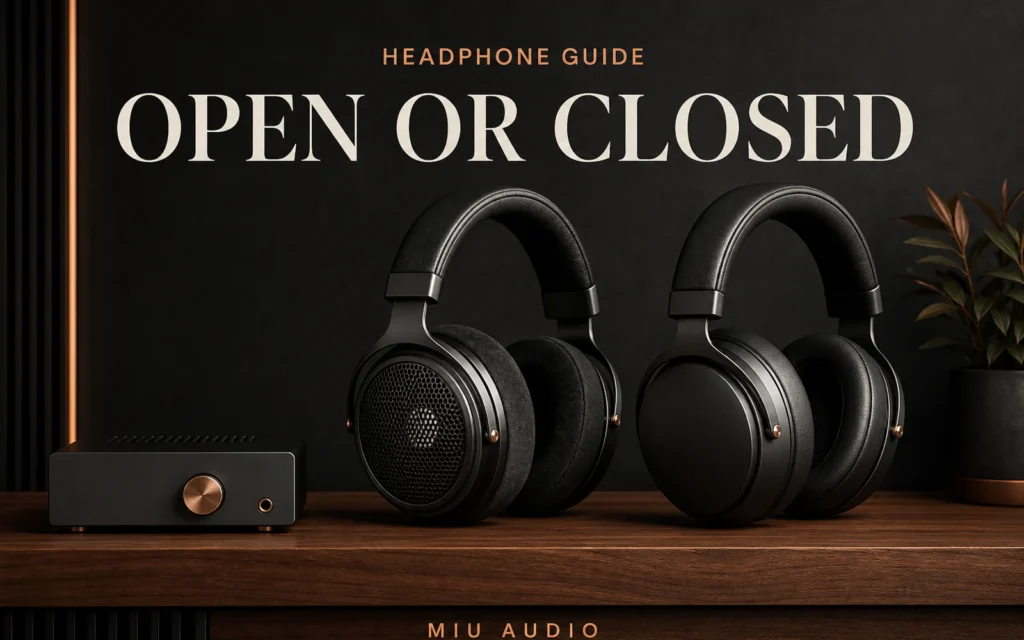
The short answer: open-back headphones suit quiet private spaces where sound leakage is acceptable; closed-back headphones suit shared rooms, travel and recording situations where isolation matters. Neither enclosure type is universally better.
Shure describes closed-back designs as providing acoustic isolation and publishes separate open-back models for critical listening. Those categories guide use, while fit, tuning, impedance, sensitivity and individual comfort still decide the final match.
Start with the room, not the soundstage claim
Open-back earcups allow sound to pass through the enclosure, so outside noise enters and music leaks out. In a quiet room, that can be acceptable; beside another person, microphone or commuter, it may be impractical.
Closed-back cups reduce leakage and external sound to varying degrees. They do not provide the same isolation as every active-noise-cancelling design, and the exact seal depends on fit and pads.
Compare use cases before tonal preference
| Situation | Likely starting type | Reason |
|---|---|---|
| Quiet private room | Open-back | Leakage is less disruptive |
| Shared home or office | Closed-back | More isolation and less leakage |
| Microphone recording | Closed-back | Reduces playback spill |
| Hot long sessions | Compare both | Pad and clamp comfort vary |
Fit changes both comfort and bass
A closed-back headphone often relies on a consistent pad seal. Glasses, hair and worn pads can alter low-frequency response. Open-back models can still clamp, create pressure points or feel heavy.
Wear each candidate for at least several normal-length excerpts. Check jaw movement, glasses, headband hotspots and heat rather than judging only the first minute.
Match the source after choosing the enclosure
Impedance and sensitivity determine how the headphone interacts with a phone, laptop, DAP or amplifier. Do not assume an open-back model always needs a powerful amp or a closed-back model is always portable.
Compare specifications and listen for adequate clean volume with headroom. Begin low, especially when switching between models of different sensitivity.
Run a practical leakage test
- Set the headphone to your normal listening level.
- Ask another person to stand at the relevant distance.
- Pause and note the room noise entering the earcups.
- Play speech and music to check leakage.
- Repeat with the other design at matched perceived loudness.
- Choose based on the real shared-space requirement.
Practical checklist
- The normal room and nearby people are considered.
- Leakage and isolation are tested at realistic level.
- Fit is checked with glasses and normal posture.
- Pads create a consistent seal where required.
- Impedance and sensitivity suit the source.
- Comparisons use similar loudness.
- Long-session heat and clamp are noted.
Troubleshooting guide
| What you notice | Check first | Next step |
|---|---|---|
| Closed-back bass is inconsistent | Pad seal, glasses and worn cushions | Refit and inspect approved replacement pads |
| Open-back sounds thin in a cafe | External noise masking | Use a more isolating design |
| Others hear the music | Open-back leakage and level | Reduce level or choose closed-back |
| Headphone is uncomfortable after ten minutes | Clamp, weight, pad heat and headband | Do not expect sound preference to fix fit |
Continue your Miu Audio research
Use Miu Audio's showroom guidance to prepare a controlled headphone audition, but check current product availability before travelling because no unconfirmed model is implied by this guide.
- Explore the confirmed Miu Audio LS3/5a
- Browse Audiophile Hi-Fi guides
- Plan a Springvale showroom visit
Frequently asked questions
Do open-back headphones sound better?
Not universally. They often suit quiet private listening, but tuning, fit and source matching matter more than enclosure type alone.
Can people hear open-back headphones?
Yes, they leak sound by design. The amount depends on model and level, so test at the distance relevant to your shared space.
Are closed-back headphones good for home listening?
Yes, especially when isolation, late-night use or shared rooms matter. Compare comfort, seal and tonal balance for the exact model.
Do closed-back headphones block all noise?
No. Passive isolation varies, and low-frequency environmental noise may remain. Active noise cancellation is a separate feature.
Sources
- Open Back vs. Closed Back Headphones, Shure, accessed 30 July 2026.
- SRH1540 User Guide, Shure, accessed 30 July 2026.
- Miu Audio Showroom, Miu Audio, accessed 30 July 2026.
Headphone isolation, leakage and fit vary by model and listener. Begin at low level, compare in the real use environment and verify current products before planning an audition.