
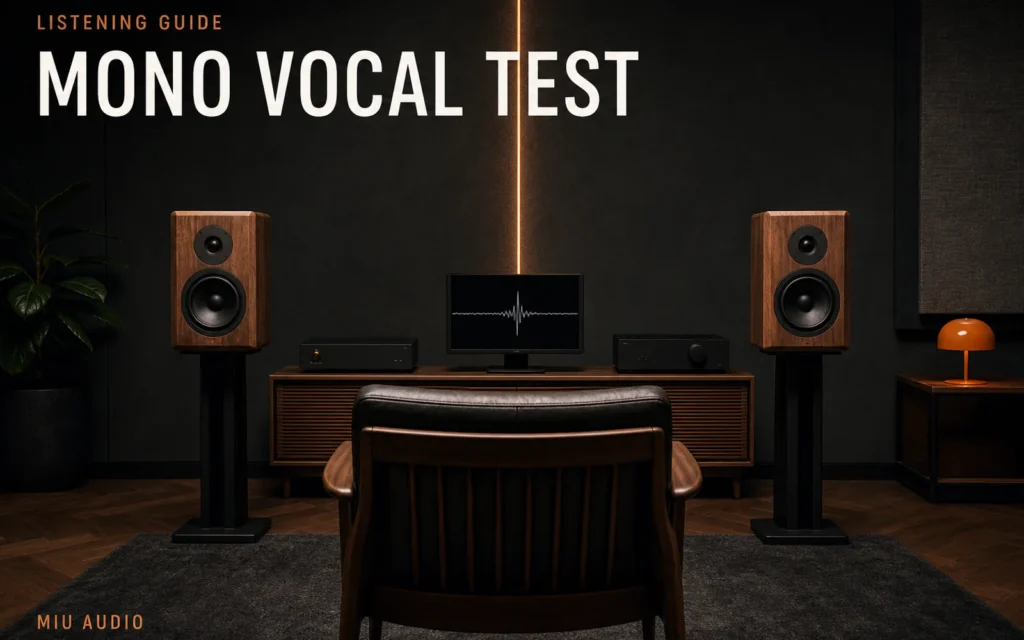
The short answer: play a true mono voice through both channels at moderate level and sit exactly between the speakers. In a well-matched setup, the voice should form a stable phantom image near the centre rather than seeming to come from both cabinets separately.
This test does not prove perfect frequency response, but it is sensitive to unequal distance, reversed polarity, channel level and early-reflection differences. The BBC LS3/5A report discusses stereo-image assessment from a defined listening geometry, while Genelec emphasises left-right symmetry for accurate imaging.
Confirm the source is actually mono
Use a mono recording or a player function that sums correctly to mono. A vocal merely panned to the centre in a stereo mix may include stereo ambience, doubled parts or processing that makes the image wide.
Keep all spatial enhancement, crossfeed and room-processing settings documented. The test is only useful when you know what signal reaches the speakers.
Set the geometry before listening
- Measure equal left and right speaker distance to the seat.
- Match stand height and cabinet front position.
- Confirm positive and negative wiring on both channels.
- Set equal initial toe-in.
- Sit with your head on the centre line.
- Play the mono voice at a comfortable moderate level.
Interpret the centre image
A voice that pulls consistently left or right suggests distance, channel level or reflection imbalance. A diffuse voice with weak bass can indicate one reversed channel. A centre that moves dramatically with a small head shift may reflect strong toe-in or nearby surfaces.
Do not diagnose a defective loudspeaker from one recording. Repeat with a second mono source and swap no cables until visual wiring is checked.
Change one variable at a time
Correct distance first, then polarity, then angle. If the image still pulls, inspect nearby side walls and furniture. Move a speaker only in small measured increments and preserve the previous mark.
Avoid using channel balance to cover a physical distance error. If balance is needed after placement, record the exact setting and verify it across frequencies.
Return to stereo music for the final check
Once the mono voice is stable, play a familiar stereo track. Listen for a natural spread around the centre, not a spotlight effect. Good mono focus should support stereo coherence without forcing every recording into a narrow point.
Check two seats if shared listening matters. The central test is a diagnostic reference, not the only valid place to enjoy music.
Practical checklist
- A verified mono source is used.
- Speaker-to-seat distances are equal.
- Both channels have matching polarity.
- Stand height and toe-in are equal.
- Processing settings are known.
- Two mono sources confirm the observation.
- Stereo music validates the final result.
Troubleshooting guide
| What you notice | Check first | Next step |
|---|---|---|
| Voice pulls left | Left speaker distance, level and reflection | Measure both paths before changing balance |
| Voice is wide and bass is thin | One channel reversed | Power down and inspect polarity |
| Voice shifts with a tiny head move | Strong toe-in and close reflections | Reduce angle slightly and retest |
| Different mono tracks give different results | Source processing or recording | Use a known clean test source |
Continue your Miu Audio research
Use the mono test after completing the basic Miu Audio LS3/5a stand and distance setup. It is a fast way to verify the baseline before fine toe-in or room adjustments.
- Explore the confirmed Miu Audio LS3/5a
- Browse Audiophile Hi-Fi guides
- Plan a Springvale showroom visit
Frequently asked questions
What should mono sound like on two speakers?
From the central seat, a clean mono source should normally appear as a stable phantom image near the centre, with both speakers contributing coherently.
Why does a mono vocal sound wide?
Possible causes include a stereo-processed source, reversed polarity, unequal distance, reflections or deliberate loudspeaker dispersion. Verify the source and wiring first.
Can I use pink noise instead of a voice?
Noise is useful for level and tonal checks, but a familiar dry voice makes centre location easy to describe. Use safe levels and appropriate test material.
Should mono come from one speaker?
For this stereo setup test, the same mono signal plays through both speakers and creates a phantom centre. A single-speaker check answers a different question.
Sources
- The design of the miniature monitoring loudspeaker type LS3/5A, BBC Research Department, accessed 30 July 2026.
- How To Place Your Monitors, Genelec, accessed 30 July 2026.
- Methods for the subjective assessment of small impairments in audio systems, International Telecommunication Union, accessed 30 July 2026.
The mono vocal test is a placement diagnostic, not a complete measurement. Verify wiring with power off, use safe levels and assess multiple sources before concluding that equipment is faulty.