
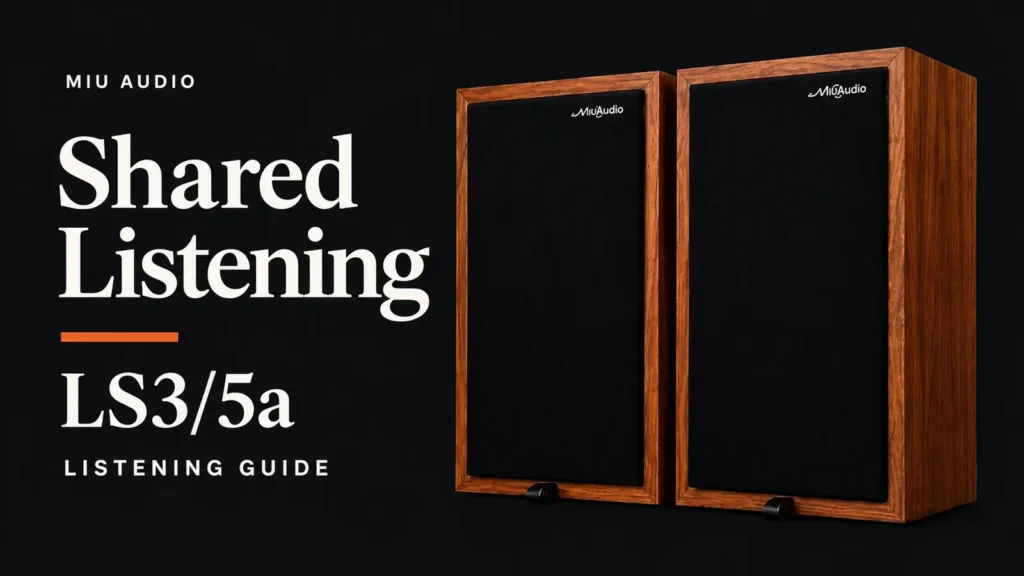
For two people listening to an LS3/5a system, start with a repeatable central reference seat, then compare each person's normal position without changing the music or volume. Swap seats before moving the speakers. The aim is to understand what each listener hears and find a practical compromise, not to promise an identical stereo image across a whole sofa.
A living room is rarely used by one person in one fixed chair. One listener may sit near the centre, another beside an armrest, while the same space also serves as a reading or conversation area. A useful demonstration should reflect those habits. This guide focuses on shared listening rather than a single-seat placement prescription.
Define what both listeners need
Before adjusting anything, each person should describe one ordinary listening situation. Is it a complete album after dinner, a short vocal playlist, or quiet music while reading? Agree whether the priority is an attentive shared session or convenient listening from several places.
Write down two or three questions you can actually answer during the comparison. Can both listeners follow the vocal without asking for a higher level? Does either seat make particular notes seem unusually prominent? Is the arrangement comfortable enough for the length of session you enjoy?
Keep personal preferences separate from claims about the loudspeaker. A listener who favours one presentation is not establishing a technical measurement, and disagreement does not automatically mean the system is faulty.
Establish one reference position
Miu Audio presents the LS3/5a as a compact bookshelf monitor. Use the current LS3/5a product overview for model information; do not assume that every loudspeaker with a similar historical name has the same requirements.
Genelec's placement guidance explains that room reflections and the listener's position affect what is heard. It uses left-right symmetry, comparable speaker height and a central listening position as reference conditions. Those general principles help establish a baseline; Genelec's model-specific positioning distances are not instructions for an LS3/5a.
Choose a central position where the listener is approximately the same distance from the two speakers. Record it before testing the normal sofa seats. Keep the loudspeakers stable and follow their installation instructions. Do not balance cabinets on improvised supports to make a comparison easier.
Compare seats before changing the system
Choose two familiar recordings and identify a short passage in each. Use the same version of each recording every time. One passage might contain a clearly placed vocal; another might make it easy to follow an instrument through the arrangement.
First, listener A uses the reference seat while listener B uses their ordinary seat. Replay the passage and exchange positions. Keep the source, volume setting and speaker positions unchanged. Each listener then writes a brief observation without first hearing the other person's verdict.
Useful notes describe an event: the vocal appeared nearer the left speaker, a particular instrument became harder to follow, or one bass note drew more attention. Avoid turning every observation into words such as better or worse. You need enough detail to distinguish a seat difference from a preference difference.
If an observation follows the seat when the people exchange places, investigate the room position before attributing it to either listener's hearing or to the product. This comparison is an informal listening exercise, not a diagnosis or a calibrated acoustic test.
Test one practical compromise
Once you understand both seats, consider a small change that can be reversed. Moving the seating position slightly towards the centre may be easier than rearranging the whole system. Alternatively, a modest, equal speaker-angle change might be worth testing if it remains consistent with the loudspeaker's instructions.
Choose one variable, note the original setting and repeat the same passages from both seats. Do not simultaneously move the sofa, change the amplifier setting and select a new recording. A result produced by several changes is difficult to interpret.
Ask both listeners whether the change addresses the question written at the start. A narrower stage may suit one person and not the other. A central image that is more stable from the reference seat may still be less convincing from the sofa edge. Record the trade-off rather than claiming that one adjustment solves every seat.
Return to the original arrangement when the result is unclear. Doing nothing is a reasonable decision when a change creates inconvenience without an agreed listening benefit.
Keep the room usable
A listening layout must also work as a living space. Keep walking routes clear, avoid stretched cables across the floor and preserve stable support for the loudspeakers. Do not sacrifice equipment ventilation, cable safety or access to doors for a preferred listening angle.
Take a simple photograph of the completed arrangement for your own records and note the seating and speaker positions. This makes it easier to repeat the test after furniture moves. It is not evidence of measured performance or a testimonial.
For longer sessions, let each person choose a complete familiar track after the short comparisons. Listen at a comfortable, conservative level and stop rather than increasing volume to overcome an unexplained difference. The short exercise should support enjoyment, not turn every album into a technical inspection.
A shared-listening checklist
- Both listeners have described their normal listening situation.
- A central reference position is recorded.
- The same recordings, passages and volume setting are used.
- Each listener tries both seats before any equipment changes.
- Observations describe what happened rather than promise an improvement.
- Only one reversible change is tested at a time.
- Stable supports, walking routes and equipment instructions remain priorities.
- The chosen compromise is checked with a complete track.
Frequently asked questions
Can two sofa seats have an identical stereo image?
Do not assume so. Different positions relative to the loudspeakers and room surfaces can give different impressions. Compare your actual seats and decide which trade-offs are acceptable rather than expecting an identical result everywhere.
Should we turn up the volume when one seat sounds different?
Keep the volume setting unchanged during the seat comparison. Raising it introduces another variable and does not establish the cause of the difference. If the system behaves unexpectedly, stop and check the relevant equipment instructions.
Do we need to move the LS3/5a speakers straight away?
No. First exchange seats and repeat the same passage. A seating adjustment may be the more practical option. If you do move or angle the loudspeakers, record the starting position and change only one variable at a time.
Does this guide guarantee that LS3/5a suits our room?
No. Room behaviour, system compatibility and personal preferences vary. Use the exercise to prepare useful questions, confirm the exact model information and arrange an appropriate demonstration before making a purchase decision.
Continue your Miu Audio research
Learn more about the Miu Audio LS3/5a, read the small-room setup guide, or check current showroom information. Confirm demonstration arrangements directly before travelling. This guide makes no stock, price or availability claim.
Sources
- Miu Audio Featured Products, Miu Audio, accessed 8 October 2026. Used for product identity and the Australian Learn More destination, not stock or compatibility.
- How to Position Studio Monitors and Find the Best Listening Position, Genelec, accessed 8 October 2026. Used for general positioning, symmetry and reflection principles, not Miu Audio measurements or model-specific installation distances.
Room behaviour and listening preferences vary. Follow the loudspeaker and amplifier manufacturers' instructions, keep supports and connections safe, and use these steps as a starting point rather than a promise of performance.