
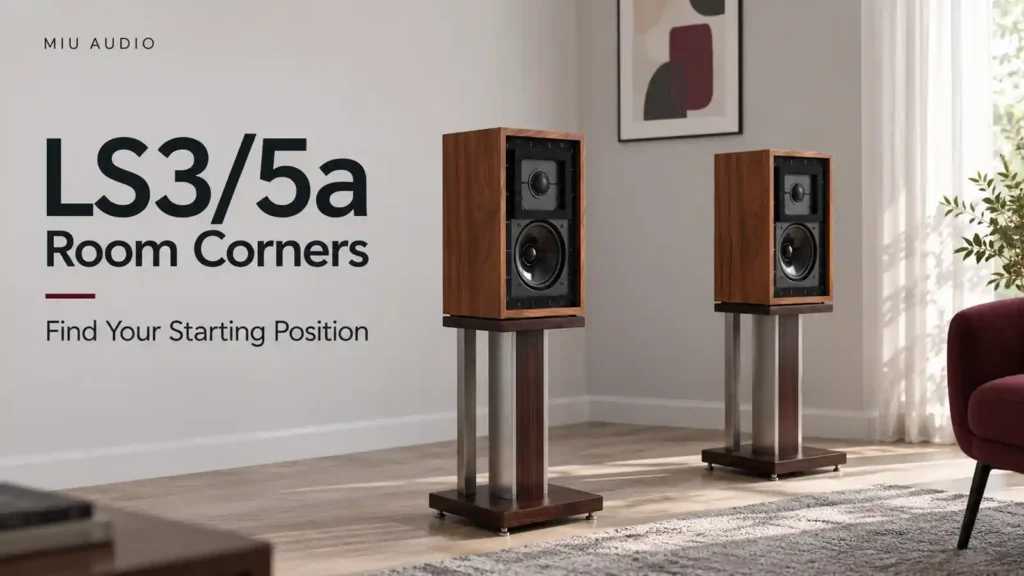
A room corner can be a tempting home for a compact loudspeaker: the floor stays clear and the system looks neatly contained. Before settling an LS3/5a pair there, give the position a proper listening trial. The useful question is not whether every corner is bad, but whether this particular arrangement lets you follow a bass line and a voice without one obscuring the other.
This guide offers a way to compare positions, not a prescribed distance for the Miu Audio LS3/5a. The correct starting point also depends on the room, furniture, stands and listening seat. Keep the manufacturer’s instructions and a safe, stable installation ahead of any experiment.
Why a corner deserves a separate check
Nearby boundaries influence what reaches the listening seat. Genelec’s placement guidance explains the general role of room boundaries and reflected sound. Its product-specific distances and adjustment settings are not instructions for an LS3/5a. The transferable lesson is simpler: the room is part of the result, so a tidy-looking position is not proof of an even response.
Look at both sides of the system. One speaker beside two walls and the other opening into a hallway are not equivalent surroundings. Note a window, heavy cabinet or deep alcove rather than assuming that equal spacing across a television automatically gives equal acoustic conditions.
Make a position card before moving anything
Sketch the room from above and mark the speaker fronts, seat and nearby walls. Add a photograph for your own reference. Write down the current spacing and which part of each cabinet the measurement uses. A small, repeatable change is more useful than moving both speakers and the sofa at once, then trying to remember the original sound.
Check that a proposed position leaves a safe walking route and does not put a stand where a door can strike it. Move equipment only as its instructions allow; do not drag a connected loudspeaker or pull on a cable. If a move would compromise stability, leave it out of the comparison.
Choose two passages, not a whole playlist
Pick a familiar vocal passage and another with a clearly shaped bass part. Use the same recording, playback settings and comfortable volume for each trial. First listen for the beginning and end of bass notes. Then ask whether the words remain easy to follow when the bass enters. These are personal observations, not measurements of the loudspeaker’s frequency response.
Write a short description such as “the last bass note hangs over the next phrase” rather than “the bass is wrong”. The first note gives you something specific to revisit. If the difference is uncertain, record that uncertainty. There is no need to declare a winner after one replay.
Compare the corner with one practical alternative
If the room permits it, compare the original arrangement with a modestly less enclosed position. Change one element at a time and keep the listening seat fixed for the first comparison. Afterwards, return to the original position. A change that still makes sense on the return visit is more useful than an exciting first impression.
Do not compensate immediately with extra volume or several tone adjustments. That makes it harder to know what the move did. Equally, do not chase an ideal diagram at the expense of how the room is used. A workable compromise may be preferable to a position that must be dismantled every evening.
Turn the result into a useful product question
Bring the room sketch, your two passages and the position notes when discussing the system. Ask which placement checks are appropriate for the exact LS3/5a version and the stands you intend to use. This is more informative than asking for a universal wall distance without describing the room.
Learn More about the Miu Audio LS3/5a, or use the Australian contact page for a model-specific question. For another listening exercise, browse the Miu Audio guides.
Frequently Asked Questions
Must an LS3/5a always be kept out of a corner?
No universal rule is established here. Compare a safe alternative in your room and consult the exact product instructions. A corner should be assessed rather than automatically accepted or rejected.
Does this guide specify a wall distance?
No. It deliberately avoids transferring another manufacturer’s measurements to the Miu Audio LS3/5a. Room dimensions, the listening seat and the installation all need consideration.
Should I move the sofa at the same time?
Keep it fixed for the first comparison if possible. Changing one variable makes your notes easier to interpret. A separate seat comparison can follow once the speaker trial is complete.
Is a listening impression the same as a measurement?
No. Your notes describe what you heard under particular conditions. They do not establish a response curve, a specification or a guaranteed result in another home.
Sources and Further Reading
Miu Audio: Featured Products identifies the model. Genelec: Monitor Placement provides general boundary and reflection context; its model-specific setup advice is not applied here.