
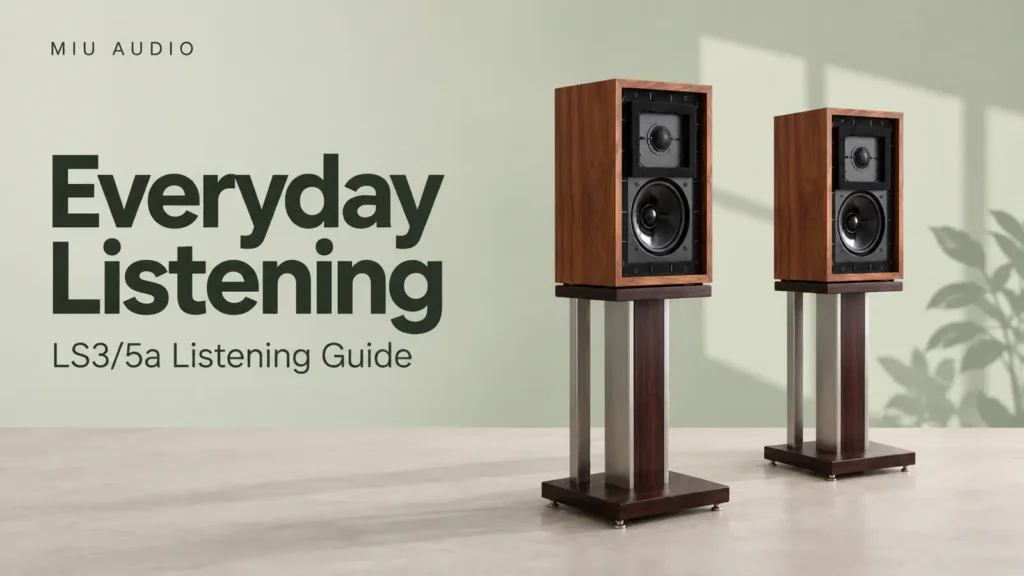
In a shared home, a useful LS3/5a listening space is one you can return to without making the room unusable for everyone else. Record a safe everyday arrangement, identify the few movable items that matter to your routine and restore those items before a comparison. The goal is a practical baseline, not a permanently closed room or a guarantee that furniture changes will improve the sound.
Start with household use
List how the space is used outside listening: access to a balcony, a work area, family seating or a route to another room. Protect those uses. Loudspeaker supports need to be stable, cables should not cross walkways and equipment access should follow the relevant manuals. Do not improvise a storage shelf or narrow ledge simply to make a photograph look symmetrical.
Agree which items can move and where they can safely go. A chair may be movable while a cabinet is not. A temporary listening arrangement that depends on someone lifting heavy furniture every evening is unlikely to remain repeatable. Treat convenience and restoration as part of the plan, rather than as obstacles to idealised setup advice.
Create a reset list, not a room makeover
Choose three or four observable starting conditions. For example, the main chair can return to a recorded position, a door can be in its usual state and the pair can stay on their established stable supports. Describe the condition in plain language. Avoid vague instructions such as 'make the room acoustically correct'.
Genelec's general placement guidance explains that a room and listening position form part of the setup context. Here that principle is only a reason to record conditions. It does not establish which curtain, chair or door state is best for your LS3/5a system, and it does not justify changing a household room without agreement.
Separate ordinary listening from comparison
You do not need to reset every movable object to enjoy music. Use the baseline when you are asking a specific before-and-after question. For casual listening, let the room work normally. This distinction prevents a helpful checklist from becoming an unnecessary ritual that makes the system harder to use.
When comparing, identify the recording edition and keep the source settings consistent. Check that the reset list was actually followed before drawing a conclusion. If the room differs, note the difference. You can still enjoy the session, but it is not a controlled comparison merely because the volume control stayed in the same place.
Keep restoration reversible and low effort
A discreet sketch or a saved note can be enough. Do not apply marks to a finish, floor or furniture without permission and a suitable method. Avoid anything that obstructs ventilation, catches a cable or creates a trip hazard. If a proposed routine requires moving powered equipment, use the relevant shutdown and handling instructions first.
After listening, return movable items to their agreed everyday positions. Check that the room remains accessible. This final step matters: a baseline that leaves the home awkward to use will gradually be ignored, and your comparison notes will lose the consistent starting point you intended to create.
Review the routine when the home changes
If a desk, sofa or cabinet changes, create a new baseline rather than silently editing the old one. Keep the previous sketch for context and date the replacement. Listen before assuming that you need new equipment. A change in furniture is a reason to reconsider the setup, not proof of a problem with the loudspeaker.
Find the LS3/5a product overview and more Miu Audio listening guides. For a room-specific question, contact Miu Audio with a simple non-sensitive sketch. This article does not confirm stock, a home installation service or a particular acoustic result.
Frequently asked questions
Do I need a dedicated room for LS3/5a listening?
This routine is designed for shared spaces. It does not establish suitability for every room; it helps you record practical conditions and ask a more specific setup question.
Must doors and curtains always stay in one position?
No. Use ordinary household conditions for everyday listening. Record their state when comparing sessions so that a changed room is not mistaken for a change elsewhere in the system.
Can I use floor marks to restore the chair position?
Only use a method appropriate to the surface and agreed by the household. A sketch or measurement note may be simpler and avoids assuming that adhesive marks are harmless.
When should I replace the baseline?
Create a new dated baseline after a meaningful layout change. Preserve the previous note rather than pretending it describes the new room, and keep any subsequent comparisons clearly labelled.
Sources and scope
Miu Audio Featured Products supplies model context. Genelec Monitor Placement supplies general room context. The shared-home reset routine is editorial planning guidance, not a model-specific acoustic prescription.