
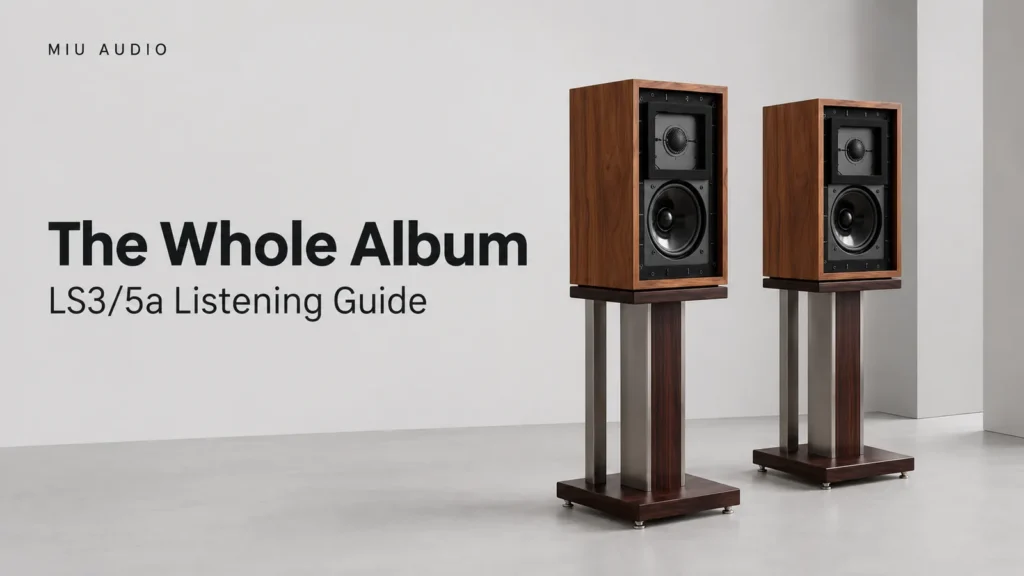
For a fuller impression of listening with LS3/5a, play an album in order rather than deciding from its opening track alone. Keep the recording edition and playback settings consistent, choose an ordinary comfortable level and note where you want to keep listening. A complete album session is a personal listening exercise, not a product measurement or a promise that every recording will suit your preferences.
Let the album define the session
A favourite opening track can become a very effective shortcut. It can also dominate your expectations. An album may include quieter passages, different instrumentation and a closing section that asks a different question of your attention. Listening in sequence gives those choices room without turning every song into an equipment verdict.
Choose an album you genuinely want to hear. It need not be an audiophile demonstration release, and this guide does not prescribe specific artists. Confirm the edition and decide whether you will play it from a local file or one service. Leave a playlist of unrelated highlights for a different session so that your purpose stays clear.
Check continuity rather than chasing settings
Before starting, look at the queue and the playback features you already use. Note any crossfade, shuffle or automatic continuation settings. Spotify's volume-normalisation help explains its song-level balancing function; that description is not a rule for how every other service handles album playback. Consult the help for your own app if you are uncertain.
Do not change settings repeatedly while the album plays. If you want to explore a feature, make that a separate exercise later. For this session, the useful question is whether the chosen routine lets you follow the record comfortably. Keep unrelated notifications from becoming an excuse to restart the same track over and over.
Use three brief checkpoints
Write a sentence after the opening section, one around the middle and one at the end. Ask different questions at each point. At the start, note whether the music draws you in. In the middle, note whether you are still following the arrangement. At the end, note whether you wanted another track, another album or a break.
These are reports of your own experience, not evidence of a universal sound signature. An interruption, a poor recording or a restless evening can affect a session. Include that context. A note saying 'paused twice for the doorbell' is more honest than attributing every change in attention to the equipment.
Avoid a running scorecard
An album session does not need a numerical rating for bass, treble and soundstage on every track. Constant scoring can turn the music into a sequence of tasks. If one passage stands out, note its location and return to it afterwards. During the first pass, let the whole record supply the context.
Afterwards, distinguish the recording from the playback experience. You may dislike a production choice while enjoying the music, or enjoy a particular track more than the album as a whole. A useful conclusion identifies that distinction rather than declaring the LS3/5a system either perfect or unsuitable on the basis of one moment.
Turn a listening evening into a useful next step
For a second session, choose another album with a different arrangement, not simply a louder introduction. Keep the room and settings similar where practical. If you have a specific equipment question, isolate it in a shorter follow-up comparison rather than changing the system during the album.
A small album notebook can contain the date, release link, playback route, three observations and one open question. It is enough to guide another evening without building a complicated database. Do not include streaming logins or personal information. Share only the non-sensitive music and setup details when asking for advice.
Read the LS3/5a overview, browse related listening guides, or ask Miu Audio an equipment-specific question. Confirm current availability separately; this article is not a stock announcement or an invitation to pay on the Australian site.
Frequently asked questions
Must I listen to the entire album without a break?
No. Take a break when you want one. Record the interruption if you are comparing sessions, but do not treat uninterrupted listening as a test you must pass.
Is an audiophile demonstration album required?
No. Choose music you want to hear and identify the edition. A familiar release gives your observations context without requiring a special catalogue or a claim about recording quality.
Should I change the volume between quiet and busy tracks?
Keep listening comfortable. If you adjust the level, note it rather than presenting the session as a fixed-level comparison. This exercise is about an album experience, not a loudness challenge.
Does finishing an album prove the equipment is better?
No. It records your experience in that session. Use repeatable comparisons and confirmed information for narrower equipment questions instead of converting a pleasant evening into a universal performance claim.
Sources and scope
Miu Audio Featured Products identifies LS3/5a. Spotify Volume Normalization provides app-setting context. The album routine and reflection questions are original editorial suggestions, not measured product findings.