
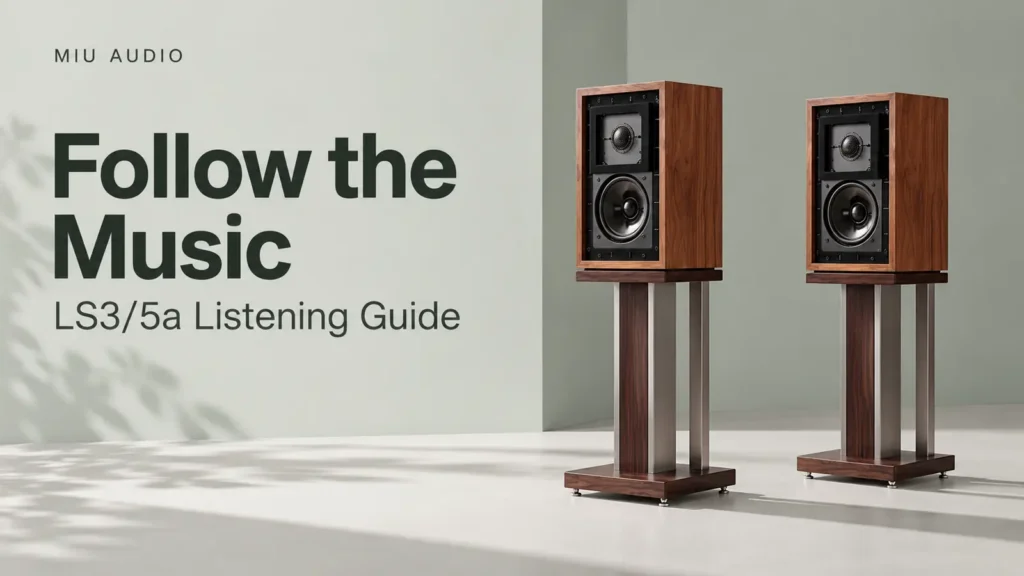
For busy music on LS3/5a, choose one short passage and follow a single part before trying to hear everything at once. Replay at the same comfortable level, then follow a different part. This can clarify what you enjoy in the arrangement without turning the session into a volume contest. It does not measure separation, maximum output or the product's performance on every recording.
Choose an arrangement you know
Pick a passage where several musical lines overlap and identify the recording edition. A familiar chorus, ensemble entrance or instrumental section can work. Choose a manageable excerpt with a clear start and finish; the busiest few seconds are not automatically the most useful material. Record the location so that you do not compare different moments by accident.
For the first pass, listen to the music as a whole. Note which part naturally attracts your attention. Do not begin with a verdict about whether the system is resolving enough. The exercise needs a musical question, such as whether you can comfortably follow a particular line through the passage.
Follow one part at a time
On the second pass, choose a line you can identify in the recording. Follow its entrance, movement and exit. On the next pass, choose another line and repeat the process. If you lose it, write down where rather than increasing the level to force it forward. The aim is an observation about that passage under those conditions.
Do not claim that following more parts proves that a system is technically superior. Familiarity, attention and production choices make the result difficult to isolate. A useful note might say that a melody was easier to follow on a later pass; it should not claim that the loudspeaker changed between those passes.
Hold the playback conditions still
Keep the recording, source route and relevant settings unchanged. Spotify explains its volume-normalisation feature as balancing song levels; note the state of that setting if you use the service. Do not assume that moving between two apps or releases leaves everything else equal. Keep a short settings note rather than relying on memory.
Use a comfortable listening level and take a break when you want one. A busy passage is not an invitation to push the system until it becomes unpleasant. If there is an unexpected fault or obvious problem, stop and seek appropriate equipment advice. This listening exercise is not a troubleshooting procedure for damaged components.
Separate density from a defect
An arrangement can intentionally place several sounds together. If a passage feels crowded, do not immediately diagnose the LS3/5a system or infer a specific production technique. Listen to the surrounding section and consider whether the dense moment is part of the musical contrast. Without production evidence, keep the observation descriptive.
You can compare a setup change using the same passage, but change only the variable you are investigating. Record the baseline and restore it afterwards. If the impression does not repeat, retain that uncertainty. A comparison that leaves you undecided can still prevent an unnecessary purchase or an unsupported product claim.
Finish with the whole track
Return to uninterrupted playback and ask whether the part-following exercise changes your understanding of the arrangement. You may discover a line you had overlooked, or decide that the overall energy matters more to you than counting individual elements. Neither result needs a numerical score or a superlative.
Keep a concise note: edition, passage, chosen part, relevant settings and an observation with its limits. Find the LS3/5a model overview, explore more Miu Audio guides or contact Miu Audio for a specific setup question. Current availability is separate from this article.
Frequently asked questions
Should I turn up a busy passage to hear more detail?
Do not use rising volume as the basis for this exercise. Start at a comfortable level and keep it consistent. If you adjust it, record the change rather than treating the passes as equivalent.
Does losing a musical line mean the system is faulty?
Not on the evidence of this exercise alone. The recording, arrangement, familiarity and listening conditions can complicate the observation. A suspected equipment fault requires a separate safe check.
Can I use a live recording?
Yes, if you want to listen to it and can identify the edition. Keep it as a distinct example; do not assume it offers the same production conditions as another recording.
How should I describe an uncertain result?
Name the passage, the part you followed and where your impression changed. State that it did not repeat if that is what happened. Uncertainty is more informative than inventing a technical explanation.
Sources and scope
Miu Audio Featured Products supplies model context. Spotify Volume Normalization explains one playback feature. The part-following exercise is editorial guidance, not a measured LS3/5a performance finding.