
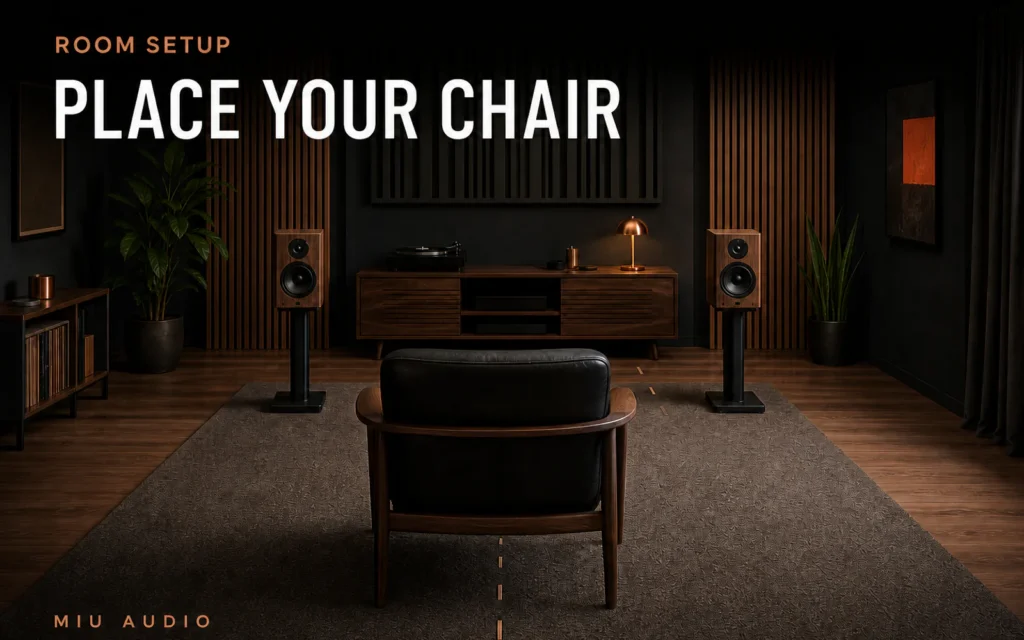
The short answer: start with the chair on the left-right symmetry line, avoid pressing it directly against a wall, and move it forward or backward in small measured steps while the speakers remain fixed. Choose the position with the most even bass and stable centre image, not simply the most bass.
Genelec explains that room modes create pressure maxima and minima and that moving the listening position can solve frequencies that appear excessive or missing. The exact result depends on room dimensions, openings, furniture and speaker placement.
Start from the room's symmetry axis
For a conventional stereo setup, place the chair so the listener is equally distant from the left and right speakers. A centre line also makes side-wall reflections more similar, which supports stable imaging.
If doors or furniture make the room asymmetric, preserve equal speaker-to-ear distances first. Do not assume that the visual centre of a rug is the acoustic centre.
Avoid locking the seat to a wall
Very close wall placement can exaggerate some low frequencies and place the listener near a pressure maximum. Moving only a small distance may change the bass more than replacing a component.
There is no universal percentage that fits every domestic room. Use rules of thumb only as initial coordinates, then test the real room.
Run a front-back position sweep
- Mark the current chair position and speaker locations.
- Play a familiar bass line with clearly separated notes.
- Move the chair forward by 10 to 20 cm and replay at the same level.
- Continue through several safe positions without moving the speakers.
- Record which notes become stronger, weaker or more even.
- Return to the best two positions and test central vocals and full tracks.
Rebuild the listening triangle after the chair moves
Changing seat distance changes the speaker angle and triangle. Once the bass position is selected, remeasure left and right distances and adjust speaker spacing or toe-in if needed.
Do not optimise bass and forget ergonomics. The chair must remain comfortable, accessible and clear of unsafe cable routes.
Use measurement as support, not decoration
A calibrated microphone and suitable software can reveal broad peaks and nulls, but measurements require correct setup and interpretation. Start with repeatable listening and physical position records before applying equalisation.
Equalisation can reduce some peaks but cannot fill a deep cancellation reliably across the room. Position is the first reversible tool.
Practical checklist
- The room centreline and normal seat are marked.
- Left and right speaker-to-ear distances match.
- The chair is not fixed against a wall without testing alternatives.
- Only the chair moves during the first sweep.
- Bass notes and centre image are assessed separately.
- The final listening triangle is remeasured.
- Walkways and cable safety remain practical.
Troubleshooting guide
| What you notice | Check first | Next step |
|---|---|---|
| One bass note dominates | Chair position relative to room modes | Move forward or backward in small steps |
| Bass disappears at the seat | Potential modal null or boundary cancellation | Test another seat before adding boost |
| Centre image shifts after moving | Equal distances to both speakers | Remeasure the listening triangle |
| Best bass position blocks the room | Practical access and shared use | Choose the best workable compromise |
Continue your Miu Audio research
Chair position and compact-speaker placement should be tuned together. Use the Miu Audio LS3/5a setup guide for stand height, spacing and toe-in after selecting the best workable seat.
- Explore the confirmed Miu Audio LS3/5a
- Browse Audiophile Hi-Fi guides
- Plan a Springvale showroom visit
Frequently asked questions
How far should a listening chair be from the back wall?
There is no universal distance. Avoid starting directly against the wall, then test small front-back moves while listening for bass evenness and centre stability.
Should the chair be centred in the room?
Left-right centring is a strong stereo starting point. Front-back placement should be tested because the exact room centre can interact poorly with some room modes.
Can room correction fix a bad listening position?
It can help some peaks and alignment issues, but deep cancellations and strong reflections often require physical placement changes first.
Should I move the speakers or chair first?
Choose a practical chair region, sweep its front-back position, then rebuild speaker spacing and toe-in. Change one variable at a time.
Sources
- How To Place Your Monitors, Genelec, accessed 30 July 2026.
- GLM GRADE, Genelec, accessed 30 July 2026.
- Miu Audio Audiophile Hi-Fi, Miu Audio, accessed 30 July 2026.
Room modes and reflections vary. Use measured, reversible moves, keep the chair and cables safe, and engage an acoustics professional for structural treatment or complex measurement.