
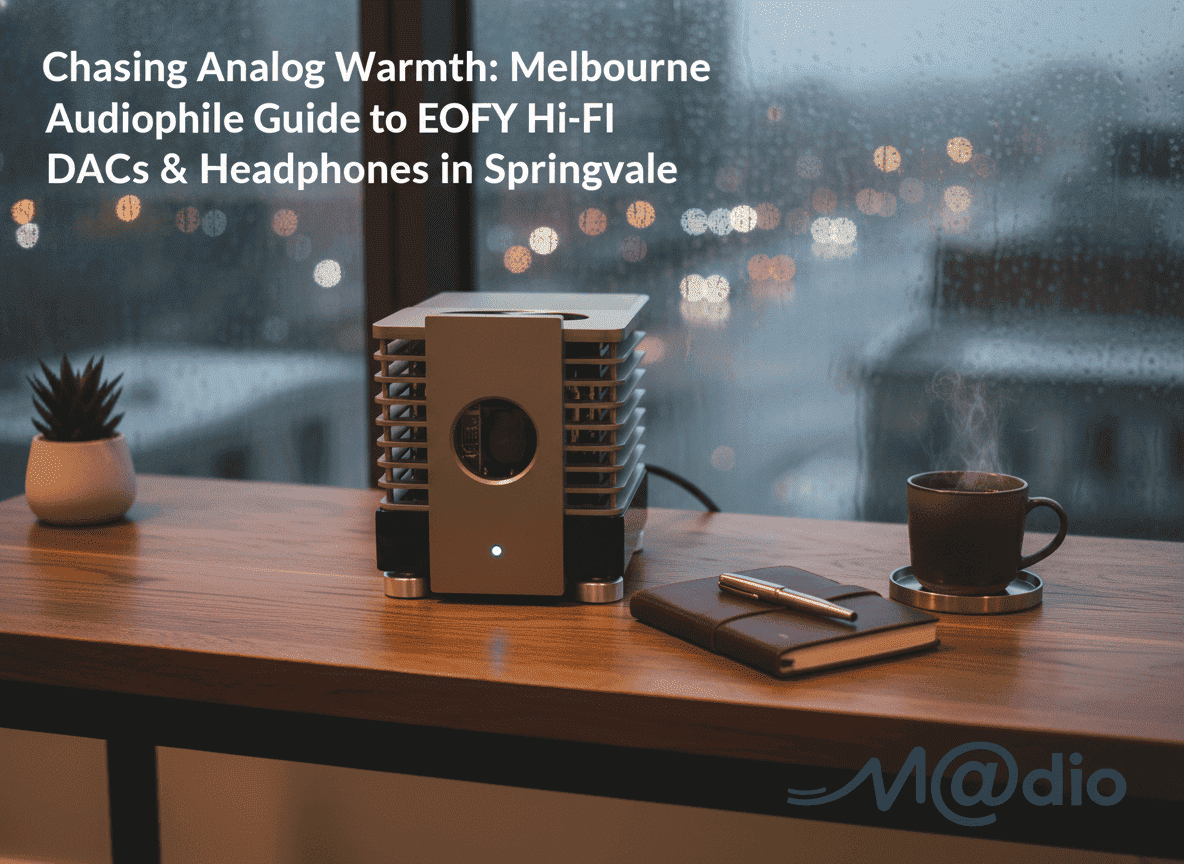
Chasing Analog Warmth: The Audiophile Guide to EOFY Hi-Fi DACs & Headphones
As the official start of Melbourne winter approaches, bringing with it freezing winds and relentless rain, remote professionals are naturally cocooning indoors. With the End of Financial Year (EOFY) aligning perfectly with this seasonal shift, optimizing your Work-From-Home (WFH) sanctuary with tax-deductible upgrades has never been more relevant. It is time to banish digital listening fatigue and embrace the ultimate winter companion: a premium desktop Hi-Fi setup featuring analog warmth.
The Antidote to Digital Fatigue
Relying on standard consumer-grade wireless headsets during prolonged remote work sessions is a recipe for exhaustion. The lossy Bluetooth compression and harsh digital amplification force your brain to constantly fill in missing acoustic details. Transitioning to a dedicated, high-resolution desktop stack—comprising a precision Digital-to-Analog Converter (DAC) and a tube or high-current solid-state headphone amplifier—delivers an effortless, expansive soundstage. This analog warmth drastically reduces listening fatigue, allowing for hours of deep, uninterrupted focus.
The EOFY Bundle Trap
As EOFY sales flood the internet, it is incredibly tempting to order highly discounted, pre-packaged audio bundles. However, reading a specification sheet cannot predict the nuanced acoustic synergy between a DAC and an amplifier. A DAC praised online for its “clinical detail,” when blindly paired with the wrong amplifier, can easily result in a harsh, sibilant treble that is actively painful to listen to. True high-fidelity audio is an equation of precise matching, not simply buying the most discounted items in a cart.
Impedance Matching: The Core of Acoustic Synergy
Beyond tonal balance, the electrical relationship between your amplifier and your high-resolution planar or dynamic headphones is critical. If your amplifier’s output impedance is too high relative to your headphones, it loses its electrical grip over the drivers. This ruins the “damping factor,” instantly transforming your expensive new gear into a sluggish, muddy acoustic mess.
Headphone Impedance Matching Calculator
Because physical comfort, cranial anatomy, and electrical synergy profoundly impact your listening experience, a single online review can only serve as a starting point. Guaranteeing that your EOFY investment actively enhances your workflow requires engaging with dedicated audio communities and cross-referencing peer experiences to validate your setup before purchasing.
Frequently Asked Questions
Why do tube amplifiers pair well with winter WFH setups?
Tube amplifiers introduce rich, even-order harmonic distortion that the human ear naturally perceives as “warm” and musical. This analog glow perfectly contrasts with the cold winter weather, providing a highly immersive, fatigue-free listening experience during long work shifts.
Why are pre-packaged EOFY audio bundles risky?
Retail bundles are frequently assembled to move stock rather than optimize acoustic synergy. A mismatched DAC and amplifier can lead to a harsh sound signature. Engaging with online audiophile communities to verify the synergy of specific pairings helps ensure the tonal balance perfectly suits your individual hearing preferences before you buy.
What is amplifier damping factor?
The damping factor refers to an amplifier’s ability to control the movement of the headphone driver. A higher damping factor (achieved by keeping the amplifier’s output impedance low) results in tight, fast, and precise bass reproduction.
Separate the recording's character from your playback preference
A full-bodied recording and a playback setting you enjoy are different things. Before attributing a winter listening impression to an amplifier, create a small recording log. Choose three pieces you already know: a close vocal, a small acoustic ensemble and a fuller arrangement. Keep the edition and playback path fixed for each entry.
- For the vocal, note one word and its time position. Describe whether the body of the voice or the consonants attract your attention.
- For the ensemble, follow the bass instrument through a short phrase. Write whether individual notes are easy for you to follow, without inferring why.
- For the fuller arrangement, listen to a quiet ending as well as its louder section. Do not keep turning up the level to search for more detail.
- Repeat on another day with the same settings before assigning a preference to the equipment. An isolated impression can remain provisional.
If your player offers tone controls, record their state too. Its official equaliser documentation describes adjustments to frequency bands; a tonal change is not, by itself, evidence about an amplifier's harmonic distortion.
Recording-log FAQ
Can I compare different remasters as an amplifier test?
Keep them as separate listening entries. Changing both the recording and the equipment leaves the cause of a preference unresolved.
What if one favourite album still sounds sharp?
Record the exact passage and check it with your unchanged reference path. One album is a useful observation, not a basis for a general claim about digital sound or an entire amplifier technology.