
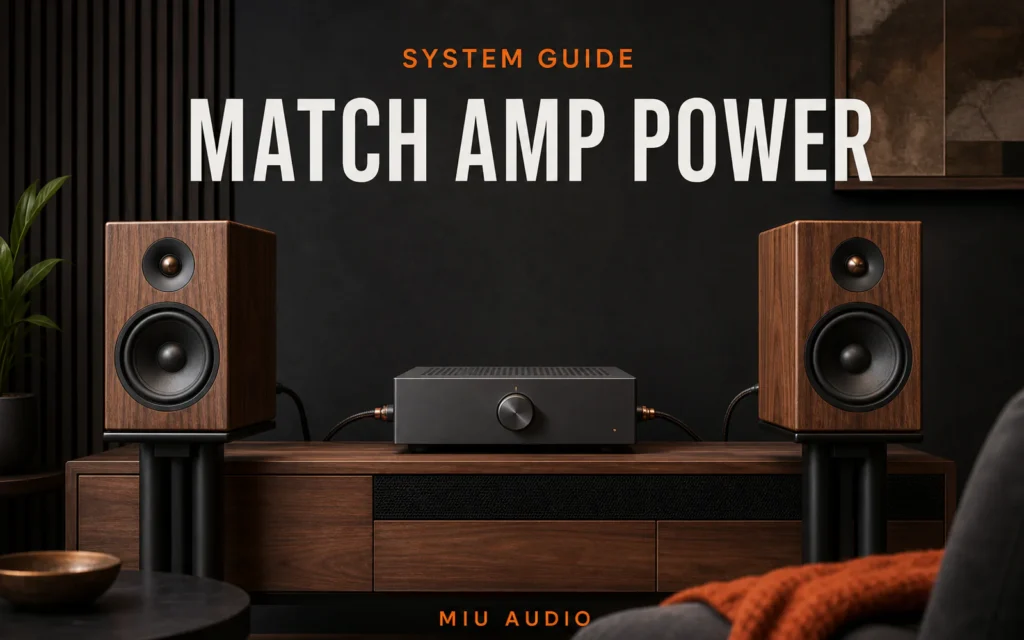
The short answer: check the amplifier's clean output into the loudspeaker's supported impedance, then consider speaker sensitivity, rated power, listening distance and room size. A speaker's watt rating is not a requirement to buy an amplifier with the identical number.
McIntosh recommends checking both power handling and impedance when choosing an amplifier. Cambridge Audio likewise explains that impedance determines the load placed on the amplifier. These are screening tools; manufacturer instructions and an audition complete the decision.
Use the power figure for the actual load
Amplifiers often publish different output into 8-ohm and 4-ohm loads. A headline wattage may not describe output into a 15-ohm loudspeaker. Use only a manufacturer-published figure or guidance for the relevant operating range.
Tube amplifiers with output taps need their model-specific connection procedure. Solid-state and transformer-coupled ratings should not be mixed into one rule.
Speaker rated power is a boundary, not a volume target
The Miu Audio LS3/5a is listed at 50 watts rated power. That does not mean it constantly consumes 50 watts or that a 50-watt amplifier is automatically ideal. Music power changes from moment to moment.
A low-powered amplifier driven into clipping can be harmful, while a powerful amplifier used carelessly can exceed speaker limits. Clean headroom and responsible level control both matter.
Sensitivity and distance determine the workload
An 83 dB sensitivity speaker in a nearfield arrangement faces a different task from the same speaker across a large room. Greater distance and higher desired peaks require more output. Room reflections alter the real result.
Estimate conservatively, then listen at the actual distance. Avoid designing around rare maximum-volume use if normal listening is moderate.
Recognise signs that the system needs less level
- Hard, gritty or compressed sound on musical peaks.
- Mechanical knocking, obvious driver distress or sudden loss of bass control.
- Amplifier protection, clipping indicators or unusual heat.
- A strong urge to keep raising volume because the setup lacks clarity.
- Channel imbalance or intermittent sound caused by poor connections.
A safe matching sequence
- Record speaker impedance, sensitivity and rated power.
- Find amplifier output and supported load for the relevant connection.
- Confirm one or two speaker pairs and any selector setting are permitted.
- Check ventilation and cable termination.
- Begin at low level with familiar dynamic music.
- Increase gradually and stop before audible strain or protection.
Practical checklist
- Amplifier output is known for the actual load.
- Speaker impedance, sensitivity and rating are confirmed.
- Normal listening distance and room size are considered.
- Multiple-speaker operation is not assumed.
- Ventilation and cable polarity are correct.
- Clipping or protection indicators are understood.
- The owner knows when to reduce volume.
Troubleshooting guide
| What you notice | Check first | Next step |
|---|---|---|
| Sound hardens on peaks | Amplifier clipping and speaker stress | Reduce level and reassess clean headroom |
| Amplifier shuts down | Load, short circuits and ventilation | Stop, inspect and follow the fault manual |
| System is quiet despite high knob position | Source level, gain and output into the load | Do not infer watts from knob position |
| Bass is weak at one seat | Room placement before power | Move speakers or chair before adding level |
Continue your Miu Audio research
The confirmed Miu Audio LS3/5a specifications provide the starting numbers for a matching discussion. Use the product page and showroom to test the complete system at a realistic distance.
- Explore the confirmed Miu Audio LS3/5a
- Browse Audiophile Hi-Fi guides
- Plan a Springvale showroom visit
Frequently asked questions
Should amplifier watts match speaker watts?
Not as identical numbers. Match the supported load and clean operating range, then consider sensitivity, distance, headroom and responsible volume use.
Can an amplifier be too powerful for speakers?
Yes, if the available power is used beyond the speaker's limits. A powerful amplifier can be used responsibly, but level control and manufacturer guidance remain essential.
Can a small amplifier damage speakers?
An underpowered amplifier driven into heavy clipping can produce damaging conditions. Reduce level when sound strains and do not rely on wattage alone.
How much headroom do I need?
It depends on sensitivity, distance, music peaks and desired level. Use conservative estimates and audition the system rather than applying one universal margin.
Sources
- Key Questions to Consider When Purchasing Your First Amplifier, McIntosh Laboratory, accessed 30 July 2026.
- What is impedance?, Cambridge Audio, accessed 30 July 2026.
- Miu Audio Featured Products, Miu Audio, accessed 30 July 2026.
Published ratings do not replace model-specific manuals. Keep within equipment limits, start at low volume, stop on distress or protection and seek qualified service for faults.