
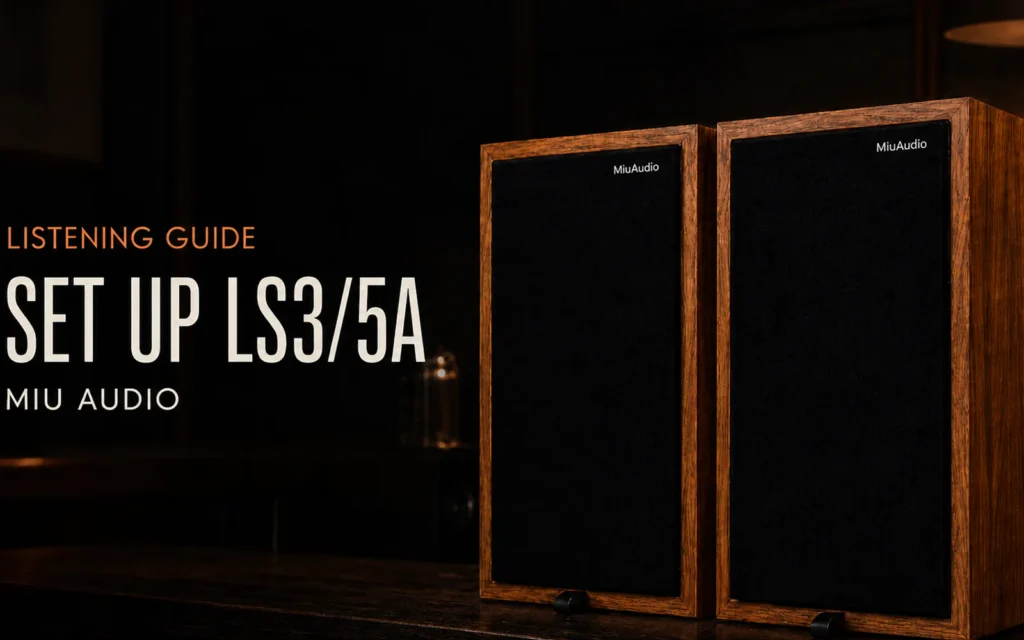
The short answer: place the speakers on rigid, equal-height stands; put the acoustic axis close to seated ear height; build a symmetrical listening triangle; and change wall distance or toe-in one variable at a time. There is no single distance that works in every room. The useful setup is the one that gives you a stable centre image, even bass and natural tonal balance from your normal chair.
This guide gives living-room, study and apartment listeners a repeatable starting method without pretending that a diagram can replace listening in the room.
Why LS3/5A setup deserves a measured approach
The BBC developed the original LS3/5A as a miniature monitor for spaces where larger designs were impractical. Its 1976 engineering report describes a compact, closed-box, two-way design. That history helps explain the format's small-room association, but it does not make every modern LS3/5A-inspired speaker identical.
Miu Audio presents its current LS3/5a Monitor Loudspeaker as a compact model inspired by that tradition. Its product overview lists 15-ohm nominal impedance, 83 dB sensitivity, 50-watt rated power and 70 Hz-23 kHz frequency response. Those facts are not room-placement instructions; room geometry, furniture, amplifier and listening distance still shape the result.
1. Start with the listening position, not the speakers
Choose the seat where you actually listen. Mark the centre of your head position with removable tape or note its distance from the front and side walls.
For a two-channel system, left-right symmetry is a strong starting point. Genelec recommends matching speaker heights and comparable distances from nearby walls. This cannot guarantee perfect acoustics, but it removes one common cause of an image pulling sideways.
In an asymmetrical room, begin with equal speaker-to-seat distances, then listen before deciding whether one speaker needs a small adjustment.
2. Use proper stands and match seated ear height
Compact speakers may fit on a bookshelf, but the shelf itself can introduce early reflections and vibration. A dedicated stand gives you more control over height, toe-in and distance from surrounding surfaces.
Set both stands to the same height and align the acoustic axis near seated ear height. Genelec uses ear-level placement as the normal reference for a typical two-way monitor. Measure your own chair position instead of copying a generic number.
Use stable, level stands rated for the speaker's weight, following the stand and speaker manufacturers' instructions.
3. Build a listening triangle
Begin with the speakers the same distance from the listener and from each other, forming an approximate equilateral triangle. A 60-degree speaker angle is a common stereo starting point and appears in the BBC report's stereo-image discussion.
Treat the triangle as a baseline. Too much spacing can weaken the centre; too little can compress the stage.
Use a tape measure rather than furniture lines. Once the geometry is equal, listen before changing it.
4. Tune wall distance by listening, not folklore
Nearby walls change low-frequency balance and reflections. Genelec explains that speaker and listener positions influence room modes, while rear-wall reflections can create cancellation related to speaker-to-wall distance. Moving a speaker can therefore change both bass quantity and evenness.
Do not copy a single wall-distance number without checking whether it was written for the same cabinet design, port arrangement and room. Instead:
- Start with both speakers the same distance from the wall behind them.
- Keep them clear of corners for the first test.
- Play a familiar track with steady bass and a clearly centred voice.
- Move both speakers forward or backward by 5-10 cm.
- Recheck the centre image, bass notes and vocal weight from the same seat.
- Record the position before trying the next move.
Listen for distinct bass notes and a midrange that is neither heavy nor hollow. Note each distance and impression so the process does not become guesswork.
5. Compare three toe-in positions
Toe-in is the inward speaker angle. It can change centre focus, stage width and treble balance.
Run three short comparisons:
- speakers facing straight ahead;
- moderate toe-in, with the speaker axes crossing behind your head;
- stronger toe-in, with the speakers aimed towards the listening position.
Keep spacing, wall distance, chair position and playback level unchanged. Use the same 30-60 second passage each time; a dry central vocal is especially useful.
Choose the mildest toe-in that gives you a stable centre and believable instrument positions. If the sound becomes sharp or overly concentrated, reduce the angle. If the centre wanders or the stage feels vague, add a small amount.
6. Check amplifier matching and channel polarity
The Miu Audio overview identifies the LS3/5a as a 15-ohm, 83 dB loudspeaker. Both figures matter, but neither alone guarantees amplifier compatibility.
Before serious listening:
- confirm that the amplifier is suitable for the loudspeaker load under the amplifier manufacturer's instructions;
- connect positive to positive and negative to negative on both channels;
- make sure the left and right channels are not reversed;
- begin at a low volume and increase gradually;
- stop if you hear obvious distress, mechanical noise or unexpected distortion.
Reversed polarity on one speaker can weaken the centre and bass. Check connections before moving furniture.
A practical 30-minute setup sequence
Use this order so that each decision has a clear purpose:
| Time | Action | What to assess |
|---|---|---|
| 0-5 minutes | Level the stands and match speaker-to-seat distances | Basic symmetry and a centred vocal |
| 5-10 minutes | Set the acoustic axis near seated ear height | Vocal clarity and vertical image stability |
| 10-18 minutes | Move both speakers forward or backward in equal steps | Bass evenness and midrange weight |
| 18-25 minutes | Compare the three toe-in positions | Centre focus, stage width and treble balance |
| 25-30 minutes | Replay two contrasting tracks at a moderate level | Whether the result works beyond one recording |
Leave the system unchanged for a day, then repeat two or three familiar tracks. A five-minute impression may not suit an evening.
Troubleshooting common results
| What you hear | First thing to check | Next small move |
|---|---|---|
| Vocal pulls left or right | Equal speaker-to-seat distance and channel balance | Correct asymmetry in small increments |
| Weak centre image | Polarity, spacing and toe-in | Reduce spacing or add mild toe-in |
| One-note or boomy bass | Corner proximity and wall distance | Move both speakers equally and retest |
| Thin bass or hollow lower midrange | Listener and speaker positions relative to room boundaries | Shift the speakers or chair slightly |
| Stage is precise but too narrow | Excessive toe-in | Reduce toe-in while keeping distances equal |
These are diagnostic starting points, not proof of a defective speaker or room. Make one change, listen, then decide.
Hear the setup before changing everything
Placement is free, reversible and often more informative than buying another component. If you are considering a compact monitor system, review the Miu Audio LS3/5a product overview and the broader Audiophile Hi-Fi range. For a reference listen, you can also check the current Springvale showroom information before planning a visit.
Frequently asked questions
What height should LS3/5A-style speakers be?
Use equal-height, stable stands and begin with the acoustic axis near your seated ear height. Measure your own chair position rather than relying on a universal stand height.
Should LS3/5A speakers be toed in?
Start by comparing no toe-in, moderate toe-in and aiming towards the listener. Keep everything else fixed and choose the angle that gives a stable centre image without making the stage unnaturally narrow.
How far should the speakers be from the wall?
There is no single distance for every room and every LS3/5A-inspired model. Begin with equal distances, stay out of corners for the first test, and move both speakers forward or backward in small matching steps while listening for bass evenness.
Do I need a powerful amplifier?
Use the published loudspeaker impedance, sensitivity and power rating together with the amplifier manufacturer's compatibility guidance. Do not select an amplifier from one specification alone, and begin listening at a low level.
Should I add a subwoofer in a small room?
Not automatically. First optimise speaker and chair placement and decide whether the remaining bass limitation matters for your music and listening level. If you add a subwoofer, follow the manufacturers' crossover, phase and level instructions and integrate it gradually.
Sources
- BBC RD 1976/29: The design of the miniature monitoring loudspeaker type LS3/5A, British Broadcasting Corporation, October 1976.
- How To Place Your Monitors, Genelec, accessed 30 July 2026.
- Miu Audio Featured Products, Miu Audio, accessed 30 July 2026.
Room behaviour and listening preferences vary. Use these steps as a starting point, follow the loudspeaker and amplifier manufacturers' instructions, and audition changes at safe listening levels.